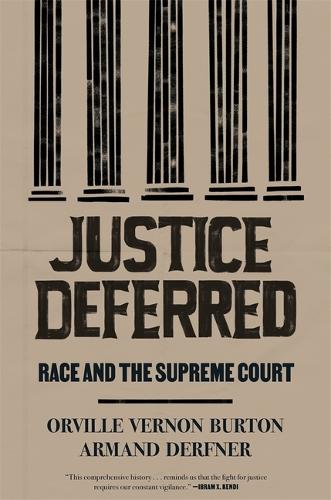
Книга Justice Deferred: Race and the Supreme Court
“[A] learned and thoughtful portrayal of the history of race relations in America…authoritative and highly readable…[An] impressive work.”
—Randall Kennedy, The Nation
“This comprehensive history…reminds us that the fight for justice requires our constant vigilance.”
—Ibram X. Kendi
“Remarkable for the breadth and depth of its historical and legal analysis…makes an invaluable contribution to our understanding of the US Supreme Court’s role in America’s difficult racial history.”
—Tomiko Brown-Nagin, author of Civil Rights Queen: Constance Baker Motley and the Struggle for Equality
From the Cherokee Trail of Tears to Brown v. Board of Education to the dismantling of the Voting Rights Act, Orville Vernon Burton and Armand Derfner shine a powerful light on the Supreme Court’s race record—uplifting, distressing, and even disgraceful. Justice Deferred is the first book that comprehensively charts the Supreme Court’s race jurisprudence, detailing the development of legal and constitutional doctrine, the justices’ reasoning, and the impact of individual rulings.
In addressing such issues as the changing interpretations of the Reconstruction amendments, Japanese internment in World War II, the exclusion of Mexican Americans from juries, and affirmative action, the authors bring doctrine to life by introducing the people and events at the heart of the story of race in the United States. Much of the fragility of civil rights in America is due to the Supreme Court, but as this sweeping history reminds us, the justices still have the power to make good on the country’s promise of equal rights for all.
"Show[s] with heartbreaking clarity how the Supreme Court has typically been more a foe than a friend to the pursuit of racial equality…[An] impressive work…Burton and Derfner’s discussion of recent Supreme Court jurisprudence offers high levels of insight, and they provide reliable guidance on controversies involving affirmative action, capital punishment, regulation of police, and other vexing subjects." - The Nation
"Extremely important and timely…When it comes to SCOTUS’s racial decisions, Burton and Derfner let the history speak for itself…It is hard to read this story…as anything other than a disappointing and dispiriting betrayal of African Americans, Native Americans, Asian immigrants, other minorities, and civil rights…Many of the stories and cases considered in Justice Deferred are utterly heart wrenching. Taken together, they are enough to make us question our trust in the Supreme Court." - Los Angeles Review of Books
"An important contribution…Burton and Derfner argue that most of the Supreme Court’s accomplishments happened from the 1930s to the early 1970s. Before then, the court ‘spent much of its history ignoring or suppressing those rights, and in the half century since the early 1970s the Court’s record on civil rights has retreated far more than it advanced.’ With clear and accessible prose, Burton and Derfner trace this disheartening story, which began during slavery and has not stopped." - The Progressive
"At best, the US Supreme Court has a mixed record when it comes to issues of race and civil rights…Justice Deferred offers a needed refresher course for faded memories on the Supreme Court’s unequal history with one of the key issues not only of our day, but one that has always been key in this country’s development—one that still requires more work." - New York Journal of Books
"A comprehensive survey of the Supreme Court’s role in the battle for racial equality. Analyzing more than 200 rulings, the authors make clear that the court has more often been an impediment to progress than an ally of it…Spanning American history from the colonial era to the present day, Burton and Derfner offer copious evidence that justices have been influenced by the politics of their respective eras…This meticulous deep dive into the court’s mixed record on civil rights is a must-read for legal scholars." - Publishers Weekly
"An extensive, thoughtful narrative charting the history and impact of race jurisprudence in the United States Supreme Court…Burton and Derfner exhaustively cover court cases and decisions from 1619 to the present (on issues ranging from Indigenous land rights to voting), explore how phrasing and word choice can uphold laws, and contextualize the relationship between these court decisions and ongoing racial discrimination in the U.S.…Superb…It will benefit scholars and students, as well as readers interested in civil rights and legal history." - Library Journal (starred review)
"A comprehensive portrait of the centrality of race in some of the Court’s most momentous decisions…We would do well to internalize the lessons of Justice Deferred as we consider the current attacks on Critical Race Theory (which isn’t taught in K-12 schools, by the way) and Nikole Hannah-Jones’ ‘1619 Project’ as they attempt to shed light on the persistence of white supremacy in America. While it, too, may be demonized for its unflinching portrayal of our racialized legal history, Justice Deferred should be required reading for anyone seeking a deeper understanding of the impact of race on American political, economic, and legal structures." - Post and Courier
"The first book to comprehensively chart the Supreme Court’s race jurisprudence. For reasons obvious to many, this book could not have come too soon. We are lucky to finally have this important history reference at a time when it seems the lessons of history can too easily be forgotten." - Trial News
"A fluent, illuminating but dispiriting book…Ingeniously shows how widely the badge of servitude—the presumption that Blacks are unfit for equal rights and opportunities—has continued to haunt race relations." - Patterns of Prejudice
"An engaging, accessible, and elegantly written analysis of the history of American race relations, framed around roughly two hundred Supreme Court cases…A superb study." - Criminal Law and Criminal Justice Books