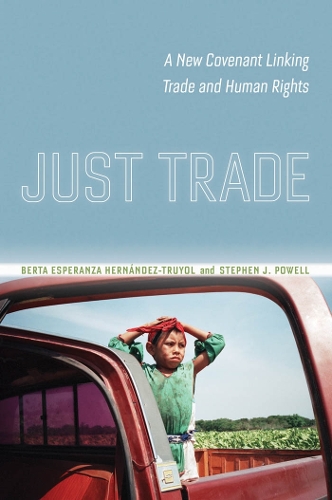
Makes a case for reaching a middle-ground between modern trade law and human rights law, acknowledging their co-existence and the significant points at which they overlap
Documents Annex: http://www.nyupress.org/justtradeannex/index.html
It is generally assumed that pro-trade laws are not good for human rights, and legislation that protects human rights hampers vibrant international trade. In a bold departure from this canon, Just Trade makes a case for reaching a middleground between these two fields, acknowledging their coexistence and the significant points at which they overlap. Using actual examples from many of the thirty-five nations of the Western Hemisphere, the authors—one a human rights scholar and the other a trade law expert—carefully combine their knowledge to examine human rights policies
throughout the world, never overlooking the very real human rights problems that arise from international trade. However, instead of viewing the two kinds of law as isolated, polar, and sometimes hostile opposites, Berta Esperanza Hernández-Truyol and Stephen J. Powell make powerful suggestions for how these intersections may be navigated to promote an international marketplace that embraces both liberal trade and
liberal protection of human rights.
"“The authors intend the book to be a catalyst for discussion and development of policy coherence in these two areas [trade rules and human rights]. They should be applauded for an ambitious, even courageous, foray into this minefield and for a carefully developed, thought-provoking presentation... As a labor rights practitioner, I found a number of these ideas thought-provoking." - Industrial and Labor Relations Review
"This work is an ambitious attempt to redefine the relationship between international trade law and the legal and moral principles of international human rights. . .an impressive book that constructs a noteworthy case regarding how trade and human rights law can be reconstituted so that they are largely coterminous and mutually supportive." - CHOICE