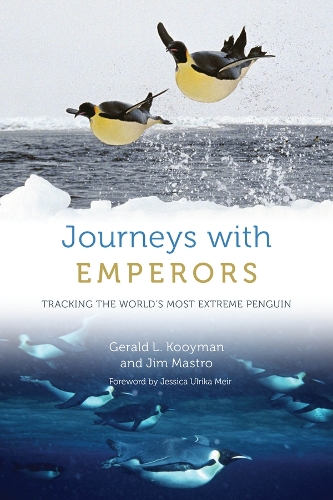
Книга Journeys with Emperors: Tracking the World's Most Extreme Penguin
With stunning photographs from the ice edge, a firsthand account of a researcher’s time in Antarctica and of the perilous journeys of the world’s largest penguin species: the iconic emperor. Nearly all emperor penguin colonies are extremely remote; of the sixty-six known, fewer than thirty have been visited by humans, and even fewer have been the subject of successful research programs. One of the largest known emperor penguin colonies is found on a narrow band of sea ice attached to the Antarctic continent. In Journeys with Emperors, Gerald L. Kooyman and Jim Mastro take us to this far-flung colony in the Ross Sea, showing us how scientists gained access to it, and what they learned while living among the penguins as they raised their chicks.
The primary mission was to record the birds’ activities at sea, and the data revealed important aspects of emperor penguin behavior and physiology: for instance, that in the course of hunting for food, some of the penguins dive to depths of greater than five hundred meters (a third of a mile, which is deeper than for any other diving bird). The researchers also discovered that, crucially, most of the emperor’s life is actually spent at sea, with fledged chicks and adults making separate, perilous journeys through icy water. When chick nurturing is complete, the fledglings abandon the colony in large groups, heading north to the Southern Ocean. The adults leave at the same time, traveling one thousand kilometers eastward across the Ross Sea to a sea-ice sanctuary for molting. During this journey, they must gain enough weight to survive the month-long molt, when every feather is replaced and the birds cannot enter the water to feed. After the molt, many if not most return to the colony to breed once again. For the males, this means another fast—this time for 120 days as they incubate their eggs. The nearness of the colony to the ice edge spared the penguins the long, energy-draining march for which other colonies are well-known. It also allowed researchers to observe the penguins’ departures to and arrivals from their foraging journeys, as well as their dangerous interactions with leopard seals and killer whales.
Featuring original color photographs and complemented with online videos, Journeys with Emperors is both an eye-opening overview of the emperor penguin’s life and a thrilling tale of scientific discovery in one of the most remote, harsh, and beautiful places on Earth.
"Informative sidebars, graphs, and charts explain technical terms in clear language. An annotated bibliography and gorgeous photos round out this treat of a book, which describes what it was like to live among emperor penguins and the challenges and rewards of research in the Antarctic. This book will have armchair travelers, penguin lovers, Antarctic enthusiasts, and science readers rejoicing." - Booklist
"The 2005 Luc Jacquet documentary March of the Penguins won an Oscar for its depiction of emperor penguins' fifty-kilometer trek over sea ice to their breeding grounds. While such a trek may be common for emperors breeding in colonies around the Antarctic perimeter, it is not the case for the largest colonies in the Ross Sea. To understand emperor penguins here, we must follow them on four critical journeys, each with its own challenges and hazards. In this compelling and accessible book, comparative biologist Kooyman and writer and fellow Antarctic explorer Mastro offer a detailed explanation of all four journeys. A book that will take you [into] the field with scientists to discover those charismatic and fascinating birds." - PolarJournal (Switzerland), "Our polar book ideas for Christmas"
" "An intriguing addition . . . Journeys with Emperors takes us behind the scenes of pioneering scientific expeditions and then follows up with the scientific results in readable, layman’s language. The bifurcated organization works thanks to the use of a single authoritative narrative voice, a careful arrangement of scientific details, and a sense of wonder that infuses every chapter, whether it’s about hiking over a glacier or the benefits of anaerobic metabolisms. It’s a very enjoyable book to read. It also gives insight into the scientific way of looking at birds and their habitat, and the personal costs and rewards of a life devoted to scientific obsession."" - 10,000 Birds