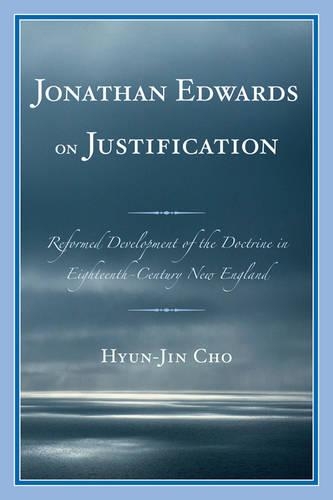
Книга Jonathan Edwards on Justification: Reform Development of the Doctrine in Eighteenth-Century New England
While several leading scholars now interpret Edwards' teaching as a quasi-Catholic departure from Reformed dogmatic tradition, Professor Cho demonstrates both variety within Reformed soteriological history and Edwards' continuity with much of it. Along the way, he places Edwards in his own time and place, post-Puritan New England, helping all of us to see the concerns that shaped Edwards' doctrine. This book represents the most important recent addition to what has become one of the liveliest interpretive conversations in the field of Edwards studies. -Douglas A. Sweeney, professor of Church history, Trinity Evangelical Divinity School This study is a valuable work in Edwards scholarship for it sheds much light on a question that has long vexed interpreters: what is the relationship between Edwards and his Reformed Protestant heritage on the nature of justification? ... By setting Edwards' doctrine of justification against the rich background of Catholic, Reformed scholastic, and Enlightenment approaches to justification, Cho admirably demonstrates the consistency between Edwards' 'dispositional' soteriology and his thoroughgoing commitments to a Reformed scholastic understanding of justification. A must-read for Edwards students who desire to understand Edwards in his historical context. -Robert W. Caldwell, assistant professor of Church history, Southwestern Baptist Theological Seminary Edwards used some puzzling terms when talking about justification-terms such as 'infusion,' 'disposition,' and 'habit'-that have led to some controversial assertions about Edwards' soteriology. Was he squarely within the Reformed tradition or not? Was he "Catholic" or "catholic"? Cho's work identifies the importance of exploring Edwards' relation to his Puritan and Reformed tradition-especially through figures such as Petrus van Mastricht, Francis Turrentin, and John Owen-as well as the ways he uniquely contributed to the development of the key doctrine as a result of his engagement with the issues of the day. Here, Edwards emerges as a negotiator of traditions and as a resource for contemporary theology. -Kenneth P. Minkema, assistant professor of American religious history, Yale University
Jonathan Edwards (1703–1758) was a preacher, theologian, and missionary to the Native Americans. This book deals with Jonathan Edwards’ doctrine of justification and its continuity with Reformed tradition. In his Reformed Theology, Edwards interprets the doctrine with scholastic as well as forensic terms such as “disposition,” “habit,” and “fitness.” Due to his use of these concepts, some scholars suspect that he had a quasi-Roman Catholic view of salvation. According to them, Edwards’ use of the terms indicates the intrinsic renovation or inherent righteousness of a saint. Contrary to this suspicion, Jonathan Edwards on Justification demonstrates that Edwards stands firmly on the Reformed tradition in the doctrine of justification. In this book, Hyun-Jin Cho presents a historical study on the theological connection between Edwards and his Reformed forebears. Based on Edwards’ dispositional ontology, the concept of “dispositional transformation” with the Holy Spirit becomes an important theoretical foundation of his doctrine of justification. Cho discusses Edwards’ attempts to explain his doctrine of justification in terms of disposition and its effects.