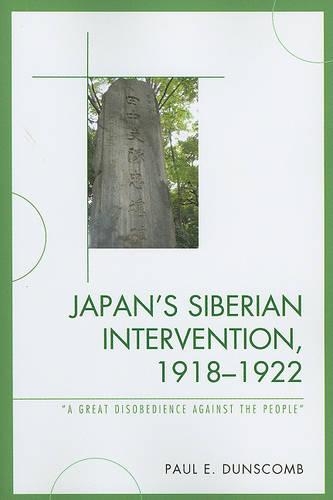
Книга Japan's Siberian Intervention, 1918–1922: 'A Great Disobedience Against the People'
The fifty months of the Siberian Intervention encompass the existential crisis which affected Japanese at virtually all levels when confronted with the new "world situation" left in the wake of the First World War. From elite politicians and military professionals, to public intellectuals and the families of servicemen in small garrison towns, the intervention was perceived as a test of how Japan might fit itself into the emerging postwar world order. Both domestically and internationally Japan's actions in Siberia were seen as critical proof of the nation's ability, depending on one's viewpoint, to embrace or to ride out the "trends of the times," the seeming triumph of constitutional democracy and Wilsonian internationalism. The course of the Siberian Intervention illuminates the struggle to cement "responsible" party cabinets at the heart of Japanese decision making, the high water mark of efforts to bring the Japanese military under civilian control, the attempt to fundamentally reshape Japanese continental policy, and the hopes of millions of Japanese that their voices be heard and their desires respected by the nation's leaders. The book attempts a broad examination of domestic politics, foreign policy, and military action by incorporating a wide array of voices through a detailed examination of public comment and discussion in journals and magazines, the major circulation daily newspapers of Tokyo and Osaka as well as those of smaller cities such as Nara, Mito, Oita, and Tsuruga.
"The story line is gripping and the book offers some new approaches. Whereas existing studies tend to finish when the japanese soldier disembarked on Russian Far Eastern soil, Dunscomb carries the story on to Japan's unilateral involvement after the Americans and Europeans had pulled their forces out of Siberia and the ultimate humbling repatriation of her forces in 1922. Dunscomb covers the diplomatic and military sides of the intervention but he blends them skillfully with public opinion, political party standpoints, newspaper coverage, and expressions of intellectual opinion. Moreover, he gives interesting vignettes of Tsuruga, a town and community adversely affected by the intervention." - Japan Forum
"In this meticulously researched volume, Paul E. Dunscomb reveals how integral Japan’s Siberian Intervention between 1918 and 1922 was to the trajectory of not simply the Japanese empire but domestic political development in the early twentieth century....The analytical framework in which Dunscomb situates the Siberian Intervention will be familiar to students of modern Japanese history. This is because he skillfully ties his study to the most innovative recent works in Imperial Japanese politics and diplomacy, particularly those of Andrew Gordon and Frederick Dickinson.1 Indeed, a major strength of the book is the precise delineation in chapter 1 of the cutting-edge historiography over the last two decades of Japanese modernity and empire....Dunscomb provides much evidence for other scholars to ponder and process. For that reason and the numerous strengths outlined above, Japan’s Siberian Intervention is now clearly the standard work on the subject." - The Journal of Japanese Studies
"In this meticulously researched volume, Paul E. Dunscomb reveals how integral Japan's Siberian Intervention between 1918 and 1922 was to the trajectory of not simply the Japanese empire but domestic political development in the early twentieth century....The analytical framework in which Duscomb situates the Siberian Intervention will be familiar to students of modern Japanese history. This is because he skillfully ties his study to the most innovative recent works in Imperial Japanese politics and diplomacy, particularly those of Andrew Gordon and Frederick Dickinson. Indeed, a major strength of the book is the precise delineation in chapter 1 of the cutting-edge historiography over the last two decades of Japanese modernity and empire....Dunscomb provides much evidence for other scholars to ponder and process. For that reason and the numerous strengths outlined above, Japan’s Siberian Intervention is now clearly the standard work on the subject." - The Journal of Japanese Studies
"Dunscomb cautions us his book is not a sequel to James William Morley’s, which focuses on “the diplomatic process by which Japan’s Siberian Intervention began,” nor is it a “campaign history” of the Japanese army in Siberia (p. 1). Rather, the book is largely a political history of the diplomatic and military entanglements the intervention posed for Japan’s policy makers at home. As such, it should be of interest to scholars of Japanese imperialism and political history, more so than military, and is a solid contribution to those fields. Dunscomb hopes that the book will spark new interest and scholarship on this often overlooked but very important episode in Japan’s modern history." - Journal of Asian Studies