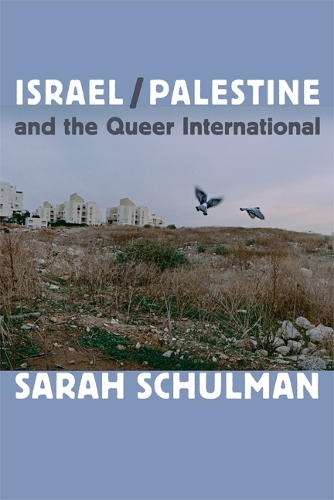
Книга Israel/Palestine and the Queer International
Kindles hope that a new "queer international" will emerge and join other movements demanding human rights across the globe
In this chronicle of political awakening and queer solidarity, the activist and novelist Sarah Schulman describes her dawning consciousness of the Palestinian liberation struggle. Invited to Israel to give the keynote address at an LGBT studies conference at Tel Aviv University, Schulman declines, joining other artists and academics honoring the Palestinian call for an academic and cultural boycott of Israel. Anti-occupation activists in the United States, Canada, Israel, and Palestine come together to help organize an alternative solidarity visit for the American activist. Schulman takes us to an anarchist, vegan café in Tel Aviv, where she meets anti-occupation queer Israelis, and through border checkpoints into the West Bank, where queer Palestinian activists welcome her into their spaces for conversations that will change the course of her life. She describes the dusty roads through the West Bank, where Palestinians are cut off from water and subjected to endless restrictions while Israeli settler neighborhoods have full freedoms and resources.
As Schulman learns more, she questions the contradiction between Israel's investment in presenting itself as gay friendly—financially sponsoring gay film festivals and parades—and its denial of the rights of Palestinians. At the same time, she talks with straight Palestinian activists about their position in relation to homosexuality and gay rights in Palestine and internationally. Back in the United States, Schulman draws on her extensive activist experience to organize a speaking tour for some of the Palestinian queer leaders whom she had met and trusted. Dubbed "Al-Tour," it takes the activists to LGBT community centers, conferences, and universities throughout the United States. Its success solidifies her commitment to working to end Israel's occupation of Palestine, and it kindles her larger hope that a new "queer international" will emerge and join other movements demanding human rights across the globe.
"“Solidarity, reciprocity, and recognition here reinforce each other, broadening the range of human rights that each movement affirms. The queer activist learns about colonialism and the anti-occupation activist learns about feminism. It is a remarkable testament to the value of the risk that Schulman ran in agreeing to deny her lesbian and gay constituency in Israel in favour of a broader human rights agenda in which their rights too might find validation and defence.”" - Dubin Review of Books
"“Written with verve and grace, Israel/ Palestine and the Queer International is eye-opening, courageous, investigative, an activists’ how-to manual, and a shining example of the best in contemporary gay liberation thinking of the sort we have come to expect from Sarah Schulman. The book is by turns hard-headed (in the best sense), clear-sighted, and tender and moving.”" - Gay City News
"“[A] provocative argument against Israel’s recent attempt to market itself as a gay tourist destination. . . . [H]er skepticism regarding power is bracing. Schulman not only upends many of her own unquestioned assumptions, she also clarifies the connection between seemingly innocuous acts, like an effusive travel-section article extolling Tel Aviv’s gay-friendly cafes, and imperialism, racial prejudice and class struggle.”" - Philadelphia Weekly
"“[Schulman] eloquently and cogently describes how her awareness and transformation happened. She presents interesting stories about the queer Palestinians she meets, and bonds with, including anti-occupation activists, as well as details about the unique coming-out process for Palestinians.”" - Philadelphia Gay News
"“Schulman offers an honest and unflinching look at her step-by-step process for challenging her own biases. It's courageous work, and something we don't see nearly enough of, especially when it comes to hot-button issues.”" - Colorado Springs Independent
"“Schulman’s ‘willful ignorance regarding Israel and Palestine’ is both acknowledged and interrogated through her own self-questioning and activism in this concise yet powerful activist-roman. . . . Is homonationalism the activist’s cry of the 21st century? Are you ready to interrogate your privilege? It is this call to acknowledge and interrogate our privilege and our ignorance that concludes Schulman’s fine work. . . .”" - Lambda Literary Review
"“Schulman’s greatest strength in this moving accuont of her politicization around Palestine is her personal exploration of how Jewish historical trauma is linked to the Israeli oppression of Palestinians. . . . This powerful narrative will be particularly helpful for folks struggling to understand the intersection of Jewish identity, queerness, and anti-occupation work.”" - Bitch
"“A great introduction to the Israeli occupation of Palestine, and to the role of queers in that struggle. Schulman offers a thoughtful, if somewhat uneven, presentation of the relationship between the two struggles, the impact of identity politics, and the devastation caused by colonialism and nationalism. She has generously taken us on her journey of self-examination and inspires others to do the same.”" - Women's Review of Books
"Israel/Palestine and the Queer International offers an insightful, critical and personal interpretation of the issues surrounding movements to divest from Israel, boycott Israel’s official economy and draw attention to Israel’s supposed pinkwashing. As always, Schulman’s writing is sophisticated, intelligent and yet accessible." - Journal of Modern Jewish Studies
"“I am hopeful that Schulman's book can help more queer folks understand the link between queer issues and Palestine solidarity, as well as how to combat pinkwashing efforts. This book can help us learn how to respond to arguments that use the concepts of dialogue, discrimination, and diversity to promote a narrow vision of gay rights aligned with state rights. By insisting on a power analysis as part of her critique of global politics, Schulman demands that we consider who is being excluded when we focus on the ‘safety’ and ‘rights’ of some LGBT folks without linking these rights to anti-colonial struggle.”" - Tikkun