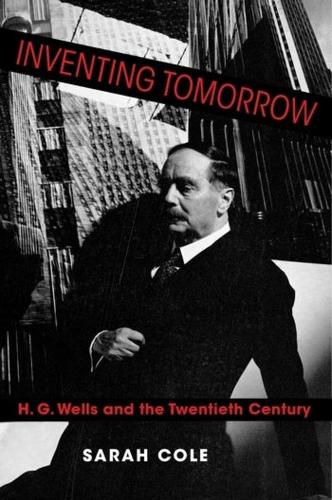
Книга Inventing Tomorrow: H. G. Wells and the Twentieth Century
H. G. Wells played a central role in defining the intellectual, political, and literary character of the twentieth century. A prolific literary innovator, he coined such concepts as “time machine,” “war of the worlds,” and “atomic bomb,” exerting vast influence on popular ideas of time and futurity, progress and decline, and humanity’s place in the universe. Wells was a public intellectual with a worldwide readership. He met with world leaders, including Roosevelt, Lenin, Stalin, and Churchill, and his books were international best-sellers. Yet critics and scholars have largely forgotten his accomplishments or relegated them to genre fiction, overlooking their breadth and diversity.
In Inventing Tomorrow, Sarah Cole provides a definitive account of Wells’s work and ideas. She contends that Wells casts new light on modernism and its values: on topics from warfare to science to time, his work resonates both thematically and aesthetically with some of the most ambitious modernists. At the same time, unlike many modernists, Wells believed that literature had a pressing place in public life, and his works reached a wide range of readers. While recognizing Wells’s limitations, Cole offers a new account of his distinctive style as well as his interventions into social and political thought. She illuminates how Wells embodies twentieth-century literature at its most expansive and engaged. An ambitious rethinking of Wells as both writer and thinker, Inventing Tomorrow suggests that he offers a timely model for literature’s moral responsibility to imagine a better global future.
"Sarah Cole’s fascinating literary investigation Inventing Tomorrow shows how H. G. Wells’s work is relevant and meaningful today. . . . The book’s scholarship combines literary criticism with biographical elements, explaining how Wells mixed details of his own life and his modernist philosophy into his work." - Foreword Reviews (starred review)
"Cole documents a thorough and thoughtful appreciation of Well's accomplishments and skills as a writer to argue for a revised estimate of his body of work." - Library Journal
"Cole adroitly captures Wells, from his mould-breaking books (such as the 1895 science-fiction classic The Time Machine and 1920 Outline of History) to his unlikely intellectual kinship with subtle modernists such as Virginia Woolf." - Nature
"[H.G. Wells] emerges from this wide-ranging account as a passionate and persistent advocate of social change, and of literature’s capacity to shape it." - The Economist
"An important new evaluation of H.G. Wells." - Wall Street Journal
"Inclusive, capacious, infectiously energetic work...Inventing Tomorrow is an invitation well worth taking up." - Politics / Letters
"While never ignoring untenable views about race and eugenics, [Cole] sees the point of him, saluting his humor and his relation to the world that formed him. Any subsequent work on Wells will have to take her as its starting point." - Wall Street Journal
"Cole’s dense, erudite and wide-ranging account demonstrates the grand sweep of his interests and ambitions." - Times Higher Education
"[Cole's] ingenious recasting of Wells as a dissident modernist seems likely to prove influential." - Times Literary Supplement
"A sympathetic and informative exploration of Wells as a writer and thinker." - Spiked
"In a landmark new study of Wells, Sarah Cole...reveals a writer whose twin obsessions with biology and history saturated his sense of humankind and its future prospects. Inventing Tomorrow restores Wells to his erstwhile centrality in the intellectual culture of the early twentieth century and unspools a “mix of attractive and repellent” ideas that resonate in an ambitious, anxious twenty-first." - New York Review of Books
"[A] substantial, well-written study." - Choice
"A magisterial book...beautifully written and persuasive throughout." - Marx and Philosophy Review of Books
"Is a deeply researched and compellingly argued defense of the author as a neglected modernist master whose work was in continuous, productive conversation with that of Woolf, Joyce, and other writers who are now more widely celebrated in the academy." - Journal of the Fantastic in the Arts
"Impressively comprehensive." - English Studies
"Cole has offered a portrait of Wells that at least acknowledges many of his shortcomings, including racism and a geopolitical vision tainted by imperialism, though these acknowledgments do not detract from her largely positive assessment of
his work" - Twentieth Century Literature