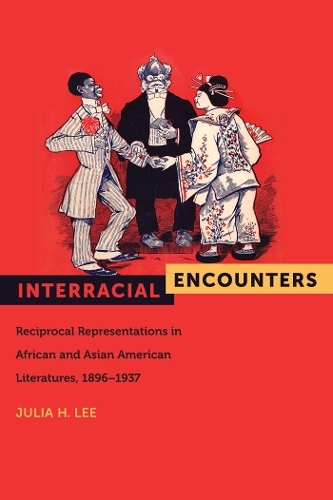
Книга Interracial Encounters: Reciprocal Representations in African and Asian American Literatures, 1896-1937
Highlights the long history of African American-Asian American relations
2013 Honorable Mention, Asian American Studies Association's prize in Literary Studies
Part of the American Literatures Initiative Series
Why do black characters appear so frequently in Asian American literary works and Asian characters appear in African American literary works in the early twentieth century? Interracial Encounters attempts to answer this rather straightforward literary question, arguing that scenes depicting Black-Asian interactions, relationships, and conflicts capture the constitution of African American and Asian American identities as each group struggled to negotiate the racially exclusionary nature of American identity.
In this nuanced study, Julia H. Lee argues that the diversity and ambiguity that characterize these textual moments radically undermine the popular notion that the history of Afro-Asian relations can be reduced to a monolithic, media-friendly narrative, whether of cooperation or antagonism. Drawing on works by Charles Chesnutt, Wu Tingfang, Edith and Winnifred Eaton, Nella Larsen, W.E.B. Du Bois, and Younghill Kang, Interracial Encounters foregrounds how these reciprocal representations emerged from the nation’s pervasive pairing of the figure of the “Negro” and the “Asiatic” in oppositional, overlapping, or analogous relationships within a wide variety of popular, scientific, legal, and cultural discourses. Historicizing these interracial encounters within a national and global context highlights how multiple racial groups shaped the narrative of race and national identity in the early twentieth century, as well as how early twentieth century American literature emerged from that multiracial political context.
"Lee's close reading of the Plessy case speaks to her book's methodological interventions. It shows the importance of literary studies in not just historical analyses of texts that have been read heretofore as concerning only blacks and whites but also Afro-Asian critique....Quite simply, the reading practice developed in Lee's book is original and insightful, and it brings to light figures and forms in late-nineteenth century and early twentieth century literatures that have often been rendered as insignificant nonpresence unrelated to other racialized figures." - Journal of Asian American Studies
"Lee's study is an invaluable addition to minority literature studies in large part because of her decision to have texts from two distinct traditions enter into conversation with one another. Her approach not only opens up these individual texts in new and exciting ways, but it also enriches and expands the understanding of race that is at their centers in ways that go beyond the traditional borders of a black and white binary." - Journal of American Culture