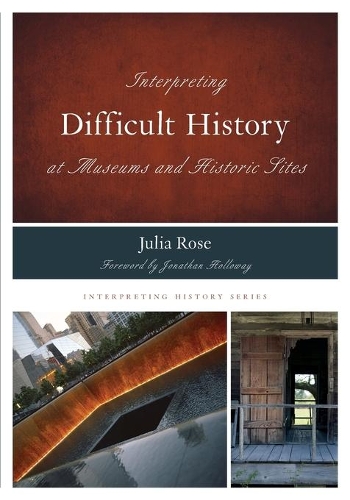
Книга Interpreting Difficult History at Museums and Historic Sites
Interpreting Difficult History at Museums and Historic Sites is framed by educational psychoanalytic theory and positions museum workers, public historians, and museum visitors as learners. Through this lens, museum workers and public historians can develop compelling and ethical representations of historical individuals, communities, and populations who have suffered. It includes various examples of difficult knowledge, detailed examples of specific interpretation methods, and will give readers an in-depth explanation of the psychoanalytic educational theories behind the methodologies. Audiences can more responsibly and productively engage in learning histories of oppression and trauma when they are in measured and sensitive museum learning environments and public history venues. To learn more, check out the website here: http://interpretingdifficulthistory.com/
"Rose provides a remarkably thorough and thought-provoking theoretical basis for displaying ‘difficult’ histories in public venues. By including an impressive bibliography of works that examine everything from memory to the psychology of the viewer to how to create intimacy in uncomfortable exhibit spaces, the author has broken new ground in how practitioners of public history should think about exhibiting the ‘history of oppression, violence, and trauma.’ Divided into six chapters, the book provides a framework for defining and displaying difficult histories, along with a discussion of the ethics that surround such memorializations. Rose concludes by providing a case study as well as the five critical elements that she posits must be included in any delivery of a difficult history. She deftly illustrates that, when dealing with difficult histories, there are multiple, often conflicting points of view that must be considered in order to accurately represent what can be a painful past. In addition, difficult histories can help viewers and learners absorb and apply the lessons learned in that uneasy space to see how their actions can undo the injustices of the past in the present. Summing Up: Recommended. Upper-division undergraduates and above." - CHOICE
"[I]t’s hard at first to heed Julia Rose’s advice in Interpreting Difficult History at Museums and Historic Sites—that when visitors brazenly deny the brutal realities of the past, we should not insist that ‘That is how the history happened’ and ‘These are the facts’ since that ‘will most likely not address learners’ discomfort.’ But Rose’s masterful book dives deep into discomfort. She is taking seriously what is required to create an environment where history workers and visitors can all finally ‘go there,’ and truly confront the most disturbing and emotional implications of American history. . . .[B]y exploring the roots of resistance, the book forces any of us who start thinking ‘I can’t do this, this is too hard’ to examine where that’s really coming from. And by bringing administrators, workers, and visitors together into a single category of learners, the book creates a sense of mutual enterprise, responsibility, and opportunity. I hope we’ll all rise to the challenge." - Exhibition
"(Reviewed jointly with Fostering Empathy Through Museums) Both books contribute to the dialogue on museums as social agents, and both address the importance of personalizing exhibitions by telling stories. They deepen the growing dialogue on the role of emotions aroused by exhibitions. As institutions increasingly present controversial issues, they need strategies for approaching anger and resistance. Rose’s Commemorative Museum Pedagogy summarizes steps that are already taken by many institutions, but in a way that puts them into relief for those who have not yet discovered those strategies…. Together, these books will be of use to museum educators, curators, and others as they strive to offer experiences in which members of the public engage with contested histories…. [B]ooks like Rose’s and Gokcigdem’s offer pathways toward a deeper consideration of the issues involved." - Museum & Society