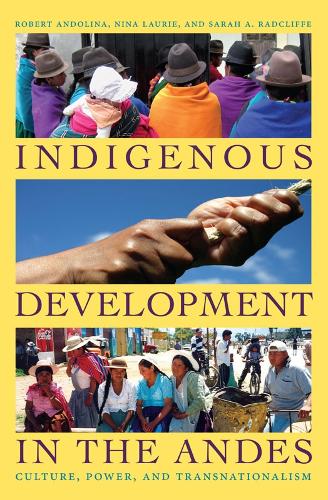
Книга Indigenous Development in the Andes: Culture, Power, and Transnationalism
Analyzes the transnational relations of indigenous politics after their shift to the global level
As indigenous peoples in Latin America have achieved greater prominence and power, international agencies have attempted to incorporate the agendas of indigenous movements into development policymaking and project implementation. Transnational networks and policies centered on ethnically aware development paradigms have emerged with the goal of supporting indigenous cultures while enabling indigenous peoples to access the ostensible benefits of economic globalization and institutionalized participation. Focused on Bolivia and Ecuador, Indigenous Development in the Andes is a nuanced examination of the complexities involved in designing and executing “culturally appropriate” development agendas. Robert Andolina, Nina Laurie, and Sarah A. Radcliffe illuminate a web of relations among indigenous villagers, social movement leaders, government officials, NGO workers, and staff of multilateral agencies such as the World Bank.
The authors argue that this reconfiguration of development policy and practice permits Ecuadorian and Bolivian indigenous groups to renegotiate their relationship to development as subjects who contribute and participate. Yet it also recasts indigenous peoples and their cultures as objects of intervention and largely fails to address fundamental concerns of indigenous movements, including racism, national inequalities, and international dependencies. Andean indigenous peoples are less marginalized, but they face ongoing dilemmas of identity and agency as their fields of action cross national boundaries and overlap with powerful institutions. Focusing on the encounters of indigenous peoples with international development as they negotiate issues related to land, water, professionalization, and gender, Indigenous Development in the Andes offers a comprehensive analysis of the diverse consequences of neoliberal development, and it underscores crucial questions about globalization, governance, cultural identity, and social movements.
"“Indigenous Development in the Andes is a hopeful and timely book. It provides important insights about the power and potential of transnationalism for indigenous development; of the tremendous agency of indigenous peoples; and the openings for governments and the international development community to learn new ways of effectively engaging indigenous populations. Readers will find these insights applicable for thinking through the challenges of how to continue to improve indigenous development outcomes in Latin America, as well in other developing nations, continents and regions.”
" - Progress in Development Studies
"“Indigenous Development in the Andes is of undeniable importance to scholars who focus on the Andean region or Indigenous Studies in general. . . . [An] engaging, well-designed, and groundbreaking study that will influence how academics and policy makers think about these issues for years to come.”" - The Latin Americanist
"“Most predominant in the book as a whole is its emphasis on scale and place. Thus, geographers will be its most natural audience, though other disciplines also may benefit from thinking through transnational relationships through a geographer’s lens. . . . The authors’ method of multisited ethnography allows them to map a huge array of discursive debates that cross local and national boundaries. . . . [T]his book certainly advances our understanding of the complexities behind the transnational production of ‘ethno-development’ policies today.”" - Comparative Political Studies
"“Moving seamlessly back and forth between examples from Bolivia and Ecuador, the authors ask how ethnic practices change development policies, and how multiethnic transnationalism emerges and sustains itself. . . . Recommended.”" - Choice
"A kaleidoscope of rural development projects in highland regions in Ecuador and Bolivia that became vital sites of local/global interactionbetween indigenous groups and the sponsors and funders of those projects." - Latin American Research Review