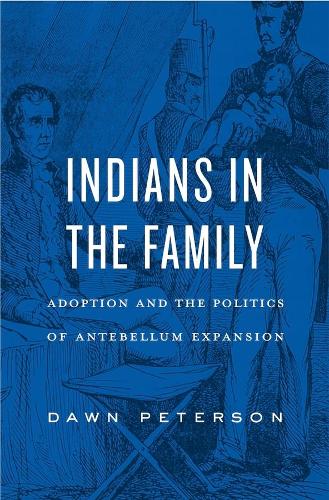
Книга Indians in the Family: Adoption and the Politics of Antebellum Expansion
During his invasion of Creek Indian territory in 1813, future U.S. president Andrew Jackson discovered a Creek infant orphaned by his troops. Moved by an “unusual sympathy,” Jackson sent the child to be adopted into his Tennessee plantation household. Through the stories of nearly a dozen white adopters, adopted Indian children, and their Native parents, Dawn Peterson opens a window onto the forgotten history of adoption in early nineteenth-century America. Indians in the Family shows the important role that adoption played in efforts to subdue Native peoples in the name of nation-building.
As the United States aggressively expanded into Indian territories between 1790 and 1830, government officials stressed the importance of assimilating Native peoples into what they styled the United States’ “national family.” White households who adopted Indians—especially slaveholding Southern planters influenced by leaders such as Jackson—saw themselves as part of this expansionist project. They hoped to inculcate in their young charges U.S. attitudes toward private property, patriarchal family, and racial hierarchy.
U.S. whites were not the only ones driving this process. Choctaw, Creek, and Chickasaw families sought to place their sons in white households, to be educated in the ways of U.S. governance and political economy. But there were unintended consequences for all concerned. As adults, these adopted Indians used their educations to thwart U.S. federal claims to their homelands, setting the stage for the political struggles that would culminate in the Indian Removal Act of 1830.
"Indians in the Family is both a nuanced history of the lives of Choctaw, Creek, and Chickasaw youths adopted into white households between the 1790s and the 1830s and an incisive investigation of Native politics and American expansion…Indians in the Family is an analytically ambitious book that begins from the premise that gender, indigenous agency, and racialization are essential to understanding the politics of American early national expansion and the entrenchment of racial slavery. The book balances its analytical rigor with attention to human subjectivity and how it shaped historical action." - Civil War Book Review
"A clear strength of the book’s framing lies in Peterson’s ability to address the perspectives and intentions of Native individuals, kin networks, and nations in the narrative to reveal how and why they diverged from their white contemporaries in the United States…Understanding how southeast American Indian nations conceptualized and used education to advance their own interests is a critical step toward reexamining the diversity of Indigenous educational experiences." - History of Education Quarterly
"Peterson has unearthed the history of keenly instinctive Indian families placing their children in white settler families with the goal of having their children gather vital information they could use later to increase economic and territorial development…Thank you, Dawn Peterson, for your meticulous research that reveals the resiliency of the early Indian families as they grappled in desperation with how they would survive encroaching white settlers and government. This rich history brings more pride in our ancestors who sacrificed years away from their children knowing in the end that this act would benefit their Indian nations." - American Indian Culture and Research Journal
"Dawn Peterson’s Indians in the Family is not only a timely reminder of how the current strategies of resistance to colonial hegemony have a long and complex history, it is itself a nuanced, rigorously documented, and beautifully written account of the quotidian tensions around race, property, assimilation, and gender that continue to influence both Indigenous studies and Native activism in the present." - Adoption & Culture