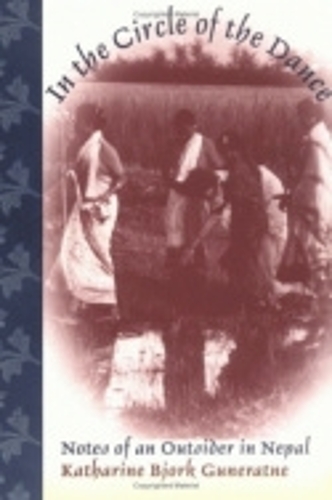
Книга In the Circle of the Dance: Notes of an Outsider in Nepal
Feeling initially aimless and out of place in rural Nepal where she accompanied her anthropologist husband for a year of fieldwork, Katharine Bjork Guneratne turned to writing to make sense of her sojourn in the shadow of the Himalaya. The resulting book is both an acute portrait of a village and an intimate account of her struggles to adapt to a different way of life. Like the best cultural travel narratives, In the Circle of the Dance draws on the author's experiences to illuminate both exterior and interior worlds.
Bjork's book is in many ways a primer on the realities of fieldwork, from setting up house to participating in the work of the village women to finding ways to communicate across cultural divides. It describes how this outsider achieved a gradual and provisional inclusion in the community, an inclusion represented by her participation in a traditional women's circle dance. The book also depicts the effects of modernization and tourism on a society that remained closed to the West well into this century, while offering comparative insights about wider South Asian cultures.
The author's lyrical, frequently moving descriptions of everyday life guide her readers through the stages of her cultural apprenticeship. In the end, as Bjork joins the circle dance, she is a stranger to the community still, but a familiar and welcome one.
Feeling initially aimless and out of place in rural Nepal where she accompanied her anthropologist husband for a year of fieldwork, Katharine Bjork Guneratne turned to writing to make sense of her sojourn in the shadow of the Himalaya. The resulting book is both an acute portrait of a village and an intimate account of her struggles to adapt to a different way of life. Like the best cultural travel narratives, In the Circle of the Dance draws on the author's experiences to illuminate both exterior and interior worlds.
Bjork's book is in many ways a primer on the realities of fieldwork, from setting up house to participating in the work of the village women to finding ways to communicate across cultural divides. It describes how this outsider achieved a gradual and provisional inclusion in the community, an inclusion represented by her participation in a traditional women's circle dance. The book also depicts the effects of modernization and tourism on a society that remained closed to the West well into this century, while offering comparative insights about wider South Asian cultures.
The author's lyrical, frequently moving descriptions of everyday life guide her readers through the stages of her cultural apprenticeship. In the end, as Bjork joins the circle dance, she is a stranger to the community still, but a familiar and welcome one.
"
Guneratne shares unforgettable images from her experience in the field as the wife of anthropologust Upali Arjun Guneratne... Her sensitivity and her humility are disarming and the result is a story as much about the landscape of human relationships as it is about the culture of Nepal.
" - Dartmouth Alumni Magazine"
Engaging... Guneratne provides insight into life in contemporary Nepal and shows how life in the field influences the inner person and continues to do so after one departs.
" - American Ethnologist"
The book is enjoyable to read. The writing is skillful, often amusing and full of insight. It will appeal to a very wide readership, and I shall be recommending it to my anthropology students. It would be good if anthropologists and ethnographers could manage to write as well as this.
" - European Bulletin of Himalayan Research"
Katherine Guneratne has created in her delightful and insightful book In the Circle of the Dance.... a thoughtful and sensitive portrait of the Tharus she got to know in a village in Chitwan in the Tarai. A compelling feature of the book is that she then also shows how her encounters with her Tharu friends inevitably shed light on her own self and her own society. It is the way she shows how this self-knowledge grew in sometimes comical fits and starts out of casual ethnographic knowledge that many readers will find especially appealing.
" - Himalayan Research Bulletin