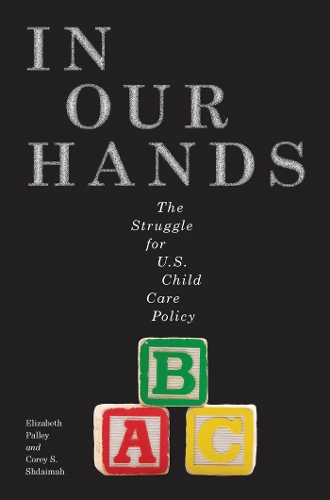
Книга In Our Hands: The Struggle for U.S. Child Care Policy
A call for better child care policies, exploring the reasons why there has been so little headway on a problem that touches so many families.
Working mothers are common in the United States. In over half of all two-parent families, both parents work, and women’s paychecks on average make up 35 percent of their families’ incomes. Most of these families yearn for available and affordable child care—but although most developed countries offer state-funded child care, it remains scarce in the United States. And even in prosperous times, child care is rarely a priority for U.S. policy makers.
In In Our Hands: The Struggle for U.S. Child Care Policy, Elizabeth Palley and Corey S. Shdaimah explore the reasons behind the relative paucity of U.S. child care and child care support. They examine the history of child care advocacy and legislation in the United States, from the Child Care Development Act of the 1970s that was vetoed by Nixon through the Obama administration’s Child Care Development Block Grant. The book includes data from interviews with 23 prominent child care and early education advocates and researchers who have spent their careers seeking expansion of child care policy and funding and an examination of the legislative debates around key child care bills of the last half-century. Palley and Shdaimah analyze the special interest and niche groups that have formed around existing policy, arguing that such groups limit the possibility for debate around U.S. child care policy.
"Palley and Shdaimah's book is at its best in revealing the tensions among child care advocates." - The American Prospect
"Adeep dive into the history of child care policy in the United States and an examination of the cultural forces which have influenced the debate as well as the lawmakers, advocates and stakeholders who have shaped the availability of child care in America today." - NBC News
"[T]he book makes a scholarly contribution with its comprehensive approach and rich detail regarding the history and current status of child care policy. Use of policy theories, furthermore, contributes to our understanding of policymaking more broadly." - Political Science Quarterly
"This books main contribution, and it is a valuable one, is to illuminate some of the specific organizational and strategic hurdles that lie in the way of a universal, government-supported child care system. Many commentators have lamented the United States failure to establish such a system, and indeed, as noted above, the first part of the book is mainly a synthesis of the substantial literature examining child care policy both outside and inside the U.S. However, Palley and Shdaimahs research into what child care advocates actually think about their own work brings a unique perspective on this issue. Their discussion of these interviews, which happily includes a number of quotes from subjects, is both interesting and thought-provoking. Based on this research, the authors are able to offer a remarkably fine-grained critique of current advocacy efforts, along with very specific recommendations for change. In Our Hands was clearly a labor of love for its two authors . . . . The book is scholarly in tone and scope, but there is an underlying note of urgency that amplifies the authors arguments." - Law and Politics Book Review
"This book offers an approachable, intelligent treatment of child care that is suitable for undergraduate and graduate academic audiences, activists, policymakers, and the general public." - Journal of Women, Politics & Policy
"The authors make a compelling case that for too long, child care has been marginalized as an issue, in part because it has been framed as a personal responsibility . . . As authors Elizabeth Palley and Corey Shdaimah document inIn Our Hands, this draconian choice between providing cash or care is not a personal failure. It is a collective failure reflected in the lack of a national child care policy." - Families and Work Institute
"This book provides a great overview of barriers within the political system and illustrates many of the unmet needs of families and children in the current system. The analysis of the child care movement as an effective social movement adds to the current literature and provides insights for practitioners about how to move forward." - Affilia
"In their quest to understand why the United States lags so far behind Western Europe in supporting early child care, Dr. Palley and Dr. Shdaimah interviewed advocates, researchers and others who have been working to address the issue." - Erudition
"Palley and Shdaimah have done a commendable job at tackling such a difficult task. Given the fragmentation of U.S. childcare policy, their rich, historical analysis provides an important integration of multiple sources of data and literature. Their interviews with respondents from a variety of interest groups, experts, and childcare advocates provide key insights into how childcare isframed and why it is not viewed as a necessary public good in the USA . . . . [T]his book makes an important contribution. It clearly shows the mechanisms underlying childcare policy developments in the USA and israther unique in its social movement approach to understanding childcare advocacy." - Community, Work & Family
"Palley and Shadaimah have produced an excellent mixed methods study on the state of child-care policy in the US. . . . This excellent book will help readers understand a difficult problem and serve as a call to arms for change." - Choice