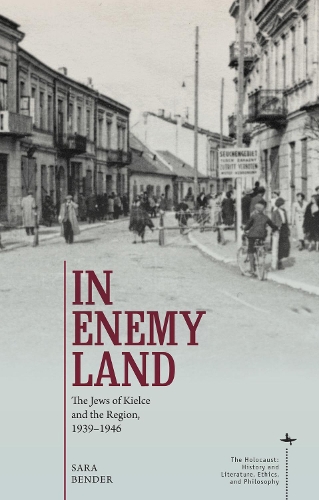
This book offers a study of the Jewish community in Kielce and its environs during World War II and the Holocaust: it is the first of its kind in providing a comprehensive account of Kielce’s Jews and their history as victims under the German occupation. The book focuses in particular on Jewish-Polish relations in the Kielce region; the deportation of the Jews of Kielce and its surrounding areas to the Treblinka death camp; the difficulties faced by those attempting to help and save them; and daily life in the Small Ghetto from September 1942 until late May 1943.
"
“Sara Bender’s In Enemy Land: The Jews of Kielce and the
Region, 1939-1946, appears at a time when Holocaust history is under new
pressures. These pressures are most evident in Poland, where a nationalist
government has seen fit – and has largely failed – to limit certain kinds of
Holocaust-related terminology if it ascribes guilt to Poles during wartime. … Bender’s
carefully researched and tightly focused study of Kielce and its environs is
not directly engaged with these discussions until its concluding chapter. But
Kielce, as is well known, was the site, in the spring of 1946, of the worst
postwar pogrom in liberated Poland. Like
the wartime events in the smaller northern town of Jedwabne, the events at
Kielce, in which 47 Holocaust survivors were murdered in mob violence, remain a
flashpoint in any postwar account of Polish-Jewish relations.” —Norman Ravvin, Canadian
Jewish News
" - Canadian Jewish News