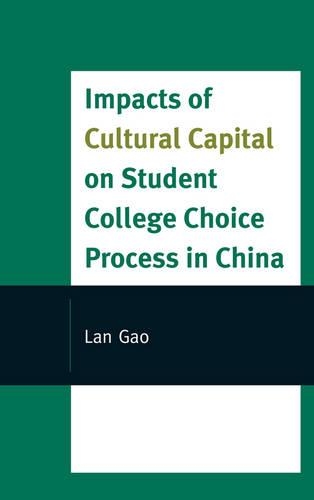
Книга Impacts of Cultural Capital on Student College Choice in China
Educational researchers have long been concerned about the factors that influence the patterns of attendance in higher education and the extent to which higher education has been accessible to all students regardless of their socioeconomic status. Extensive research has indicated that a variety of class-related factors, such as cultural capital, social capital, and economic capital, exert remarkable impacts on the amount and type of education that one receives. Drawing on cultural capital theory, this study aims at analyzing how students' college choice process varies by social class in China. By exploring different cultural and financial factors that influence different stages of students' college choice process, this study hopes to contribute to identifying the most appropriate policies and practices for raising the representation of students from the lowest social class among college participants.
"The book includes detailed yet concise literature reviews covering major theories and studies related to cultural capital and college choice, as well as changing social stratification, educational systems, and financial assistance policies in China…. The strength of this study also lies in Gao’s careful application of cultural capital theory in Chinese contexts…. To conclude, this landmark study is a welcome addition to studies of cultural capital, educational inequality, and social stratification. Gao’s work reminds us that it is critical to reassess the meaning and the role of cultural capital in relation to a nation’s educational system and cultural contexts when examining this elusive concept." - American Journal of Sociology