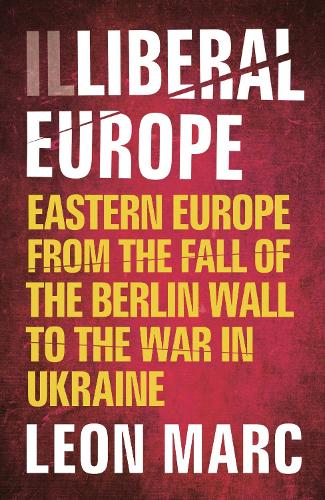
Книга Illiberal Europe: Eastern Europe from the Fall of the Berlin Wall to the War in Ukraine
Eighteen years have passed since ten countries from Central & Eastern Europe joined the European Union and more than three decades since the Berlin Wall was torn down in 1989 - but ignorance about what is popularly still called Eastern Europe is as widespread as ever. Slovenia still gets mixed up with Slovakia, the Slavs remain a mystery in a Europe apparently dominated by Romanic and Germanic nations and a country like the Czech Republic is labelled as Eastern European, although one needs to travel west to get from Vienna to Prague.
First published in 2009 under the title What's so eastern about Eastern Europe?, this book is much more than a revised and updated version of the first edition. Its presentation of the political and cultural history of Central, Eastern and South-Eastern Europe, written in an accessible language is now complemented with recent developments in the region. The new edition digs into the reasons behind the illiberal turn in Poland, Hungary and elsewhere, putting the alleged democratic backslide into the wider context of European populism. Leon Marc offers a new and fresh perspective in explaining the roots of populism and social conservatism in the region, which the book sees in a mixture of historical factors, economic conditions, the heavy burden of Communist legacy, as well as a reaction to contemporary social developments in the West. Drawing on a wide range of literature, the book calls for more sensibility to these underlying causes, critical examination of the true European values, and for a coalition of defenders of Humanism and Judeo-Christian tradition as key pillars of its identity, in order to save Europe and its liberal democracy.
This updated and expanded edition contains a brand new chapter bringing this book up to date with recent events, including Covid-19 and the Ukrainian conflict.
"Marc's analysis is particularly valuable on the growing mutual incomprehension of 'West' and 'East' over what constitute European values. For the most radical voices in Western - or perhaps Northern - Europe, to be a European is chiefly a matter of defending and enhancing certain 'liberties', notably but not exclusively in the spheres of sexuality, gender, and control over reproduction. The roots of these now dominant ideas, he suggests, are not to be found in the humanist heritage, let alone the Greek, Roman, Judaic or Christian traditions. Rather they derive from a form of hyper-individualism, which can be largely indifferent to other important, more social, imperatives, for example the welfare of the poorest classes in society or the need for national cohesion. As a result of this hypertrophy of individualist liberalism and the sidelining of social and spiritual values, the 'illiberal democrats' of Central Europe, the likes of Orbán and Kaczy?ski, have been able to present to their electorates a simplistic picture of a decadent West which poses a threat to national values while at the same time working to entrench their own and their parties' dominance in the long term" - Enda O'Doherty, Dublin Review of Books
"There is a rich tradition of diplomats being great historians and writers as well: people who combine their rich experience of political reality with a profound historical and philosophical knowledge. Among the many famous names: Machiavelli, Chateaubriand, Talleyrand, Metternich, Thomas Jefferson, Pablo Neruda, Octavio Paz, Isaiah Berlin, Henry Kissinger... With his book Illberal Europe Leon Marc makes himself part of this tradition. His book is a profound reflection of the contemporary history of Eastern Europe and the urgent lessons of that history to be learned for the whole of Europe" - Rob Riemen, Nexus Instituut
"This is a very timely book, adding an additional, well-informed and persuasively argued integral perspective on the contemporary "tragedy of the Central Europe"" - Prof Matej Avbelj, Nova University Ljubljana, author of 'The Impact of European Institutions on the Rule of Law and Democracy in Slovenia and Beyond'