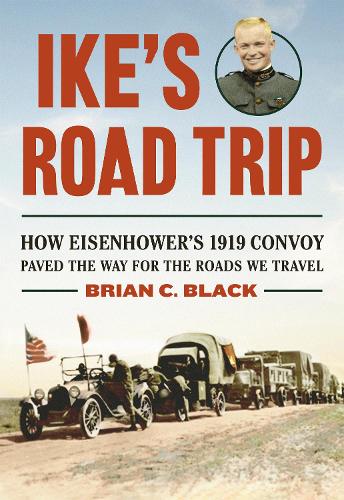
Книга Ike's Road Trip: How Eisenhower's 1919 Convoy Paved the Way for the Roads We Travel
Marketing/publicity will focus both on national as well as regional coverage in the cities and states where the convoy passed through.
The convoy drove over 3,000 miles on the historic Lincoln Highway from Washington, D.C., to Oakland, California and then by ferry to San Francisco. Key stops included Pittsburgh, Pennsylvania; Canton, Ohio; Fort Wayne, Indiana; Chicago, Illinois; Cedar Rapids, Iowa; Omaha, Nebraska; Laramie, Wyoming; Salt Lake City, Utah; and Carson City, Nevada.
Radio tour, targeting cities the convoy passed through.
Author is both an historian and environmentalist which makes him uniquely qualified to tell this story and to place it within a contemporary context.
ARC available: May 2024
All roads begin somewhere and today’s U. S. highway system began with an unforgettable, exploratory, cross-country ride, led by a 28-year-old Army lieutenant colonel, Dwight Eisenhower. This is the story of his coast-to-coast journey and how the dream of connecting America with roads began.
Before he led the liberation of Europe, before he became our nation’s 34th President, Dwight D. Eisenhower’s made a road trip in 1919 from Washington D.C. to California. The expedition proved to be a crucial chapter in the history of American culture as it laid the groundwork to make automobile travel the fastest and easiest way to move around the country, also setting in motion the nation’s future love affair with cheap crude.
The 1919 Transcontinental Motor Convoy of eighty-one trucks and other military vehicles traveled more than 3,000 precarious miles along the most famous road of the day, the Lincoln Highway, which ran between New York City and San Francisco. World War I had illustrated the importance of being able to move large amounts of troops and equipment quickly over long distances, and Eisenhower’s mission on the road trip was to evaluate whether the country’s emerging network of paved roadways could handle such a task. It was an experience Eisenhower would never forget.
“The old convoy had started me thinking about good, two-lane highways,” he later wrote. “This was one of the things that I felt deeply about, and I made a personal and absolute decision to see that the nation would benefit by it.” Decades later, as president, he drew on that experience to push through the Interstate Highway Act of 1956.
Ike’s Road Trip adds an important chapter to the story of the midwestern president who is often seen as “America’s grandfather.” Eisenhower will also be seen as a modern visionary during a pivotal moment: his persistent trust in cheap petroleum proved to be a blueprint for modern America as he helped facilitate the most significant energy transition of the twentieth century. Today, we are experiencing perhaps the most important energy transition since Eisenhower’s day—from petroleum to renewables—and that change will require minds as equally visionary as his.