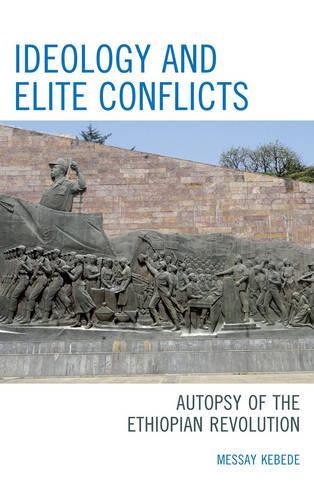
Книга Ideology and Elite Conflicts: Autopsy of the Ethiopian Revolution
The book provides a theoretical explanation of the major outcomes of Ethiopia's social revolution, namely, the overthrow of Emperor Haile Selassie in 1974 and the implementation of a far-reaching Marxist-Leninist revolution by a military committee (the Derg) and its collapse in 1991. The book extensively discusses the question of knowing whether existing theories of revolution throw light on the eruption of a radical revolution in Ethiopia and, most of all, whether they can accommodate the major anomaly of a socialist revolution being executed by a military committee that radicalized after the removal of the imperial regime. Hence the central thesis of the book: both the overthrow of the monarchical order and the radicalization of the Derg must be tied to social conditions that exasperated elite conflicts for scarce resources, with the consequence that the espousal of radical ideologies (socialism and ethnonationalism) became the sole avenue for the exclusive control of state power. Moreover, the book shows how the struggle of exclusive elites for the control of the state explains the Derg's need to put its fate in the hands of a providential leader, to wit, Mengistu Haile Mariam. In light of the theoretical debate over the role of charismatic leaders in history, the book establishes how Mengistu's narcissism led him to become the sole owner of the revolution and how his dictatorial rule brought about his own demise and that of the Derg, following the military defeat of the Ethiopian army in the hands of ethnonationalist insurgents. Another fundamental contribution of the book is a theoretical articulation of political conflicts and ideology that critically intervenes in the divisive issue of the primary cause of revolutions. Granted that ideology is more of a justification than a drive, the Ethiopian case illustrates how conflicts between mutually exclusive elites favor the path of political outbidding mobilizing utopian projects so as to galvanize the support of the masses. The perceived transcendence
"This is a very informative book as it offers much needed help for comprehending a critical period in Ethiopian history. In well-research and organized chapters, it presents a synthesis of both classical and contemporary works on revolutions in general and the Ethiopian revolution in particular. This makes it useful for readers who already know a lot about Ethiopian politics as well as for those who are novices to the subject. Moreover, the book has a multidisciplinary character and uses innovative and sophisticated analysis that makes it appealing to political scientists, philosophers, and historians and can serve as a guide to understanding revolutions in the Third World." - African Studies Quarterly