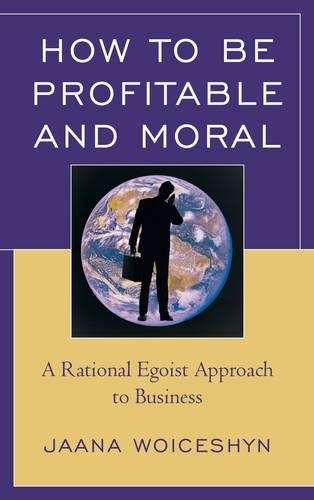
Книга How to be Profitable and Moral: A Rational Egoist Approach to Business
BB&T grew from $4.5 billion to $152 billion in assets during my tenure as chairman and CEO and weathered the recent financial crisis as one of the strongest financial institutions in America. The foundation for this success is unquestionably the principles outlined by Jaana Woiceshyn in How to Be Profitable and Moral. --John Allison, retired chairman and CEO, BB&T and Distinguished Professor of Practice, Wake Forest University Most think ethics is about self-sacrifice (altruism), or sacrificing others (cynical egoism)... Professor Woiceshyn presents an ethics that's good for you and good for business, with no sacrifice... This life-giving, rational ethics leads to personal success and happiness, and long-term profitability for business. It is a moral code for flourishing and prospering. This is an extraordinarily valuable book. --Carl B. Barney, chairman, Independence University Professor Woiceshyn has provided a well-reasoned, clearly-written explanation showing ... why business people need to live by rational moral principles as a necessary means to maximize profit. This cogent book deserves a careful reading by businesspeople, academics, and intelligent laymen alike. --Andrew Bernstein, Ph.D, author of The Capitalist Manifesto: The Historic, Economic, and Philosophic Case for Laissez-Faire
A basic dilemma confronting today’s manager is how to be both profitable and moral. Making profits through immoral means—such as deceiving investors or customers—is unsustainable. Likewise, remaining moral while losing money will cause a business to fail. According to conventional morality, either a business manager maximizes profits and necessarily compromises on ethics, or necessarily sacrifices profits in order to be moral. Woiceshyn explains why this is a false dichotomy and offers rational egoism as an alternative moral code to businesspeople who want to maximize profits ethically. Through logical argument and various examples, this book shows how to apply principles such as rationality, productiveness, honesty, justice, and pride for long-term self-interest.