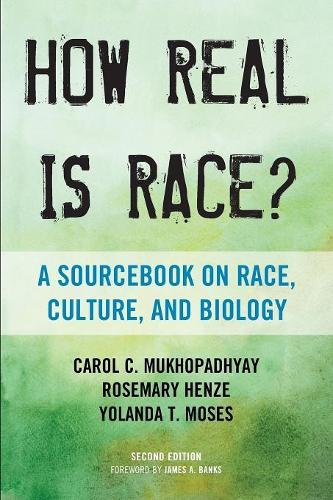
Книга How Real Is Race?: A Sourcebook on Race, Culture, and Biology
How real is race? What is biological fact, what is fiction, and where does culture enter? What do we mean by a “colorblind” or “postracial” society, or when we say that race is a “social construction”? If race is an invention, can we eliminate it? This book, now in its second edition, employs an activity-oriented approach to address these questions and engage readers in unraveling—and rethinking—the contradictory messages we so often hear about race. The authors systematically cover the myth of race as biology and the reality of race as a cultural invention, drawing on biocultural and cross-cultural perspectives. They then extend the discussion to hot-button issues that arise in tandem with the concept of race, such as educational inequalities; slurs and racialized labels; and interracial relationships. In so doing, they shed light on the intricate, dynamic interplay among race, culture, and biology. For an online supplement to How Real Is Race? Second Edition, click here.
"This book offers educators at all levels a valuable biocultural perspective on race and diversity, and can serve as a resource to enhance curriculum and pedagogy. Distinguished by its biocultural approach integrating race-related research and scholarship from biological, cultural, linguistic, and archaeological perspectives, it is intended for educators at precollege and college levels, especially for teacher education courses, and can serve as a general sourcebook for cultural diversity workshops. It is also appropriate for any reader seeking a better understanding of the concept of race and human variation. New to this edition (1st ed., 2007) is a greater emphasis on how racial identities are dynamic, negotiated, and culturally defined. The book is organized in four sections. The first questions whether racial classification is biologically valid. The second explores the concept of race as a social construct, and the third uses everyday realities of school and college to explore the way racial ideologies operate in educational settings from both student and educator perspectives. The final section presents practical applications for educators, providing a list of references, website resources, and examples of suggested activities relating to topics covered in the book. Summing Up: Highly recommended. All levels/libraries." - CHOICE
"Mukhopadhyay, Henze, and Moses’ How Real is Race? A Sourcebook on Race, Culture, and Biology is a refreshing read on the significance of understanding race not as biology, but as a sociocultural construct that operates as power. The word 'refreshing' is apropos because it achieves what has been challenging for many of us educators: the writers painstakingly explain and show how race has been and continues to be constructed through culture. And they do it in clear language—a true feat considering the complexity of the topic and the fact that this is the first book to take up the project of a 'biocultural approach' to explaining the racial construct. . . .Best assigned to students beginning on their paths of social and cultural analysis, the text offers abundant opportunities for thought, reflection, and learning. . . . [The authors] provide educators with a clear, accessible, and essential resource for thinking about and instructing on race at the undergraduate and secondary school levels. No other book offers what How Real is Race does: a 'user-friendly' handbook for educators; a detailed and thorough examination of the relationships among race, culture, and biology, and an important contribution to the literature on race theory. Purposed as a 'sourcebook,' it is wise to consider it a practical text to guide instruction on the sociocultural construction of race, wherein race is theorized as a cultural creation that has emerged from biological explanations, but is not statically cultural or inherently biological." - Teachers College Record
"Already in its second edition, How Real is Race?...is an important resource for the non-specialists interested in understanding the persistence and resilience of race within both science and daily encounters. At the same time, it is of value to specialists...who wish to compellingly engage broader audiences, while maintaining an appropriate level of scholarly sophistication. . . .[T]his book communicates an important message and an integrative approach to human life using sophisticated arguments and accessible language. It is a most appropriate book for its intended audiences and a significant contribution to contemporary discussions on race, racism, and social inequality." - Science & Education