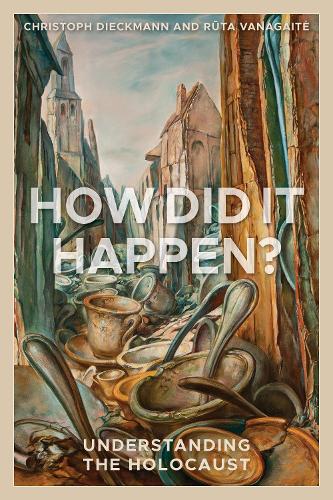
Книга How Did It Happen?: Understanding the Holocaust
Listen in on the conversation between exiled Lithuanian writer Ruta Vanagaite and noted historian Christoph Dieckmann as they struggle to understand how the Holocaust happened.
In this compelling book, Lithuanian author Ruta Vanagaite holds an extended conversation with noted historian Christoph Dieckmann. His exploration of the causes and consequences of the
Holocaust in Lithuania provides the first overview for general readers that considers the perspectives of all the central groups involved—Jews, Lithuanians, and Germans. Drawing on a rich array of sources in all the key languages—Yiddish, Ivrit, Lithuanian, and German—Dieckmann considers not only the Berlin-based orientation of the German perpetrators but also the space where the Shoah took place—Lithuanian society with its Jewish minority under German occupation. He contends that this “space” of mass crimes is always linked with warfare and occupation. The Holocaust was unprecedented, but he makes a powerful case it cannot be isolated from the other mass crimes that took place at the same time in the same space against thousands of Soviet prisoners of war and forced refugees from the Soviet territories.
Dieckmann shows that the Holocaust could not have unfolded throughout German-dominated Europe without the conditional cooperation of non-Germans in each occupied country. Existing antisemitism was radicalized from the 1930s onward, turning Jews, under the enormous stress of unrelenting warfare and often instable conditions of occupation, into what were perceived as deadly enemies. The Holocaust, its history and memory, can only be understood through this broader context. The authors’ searching exchanges illuminate the most profound questions we have as we struggle to understand the Holocaust.
"
Intended for a nonacademic audience but without oversimplifying, this analysis of the destruction of the Lithuanian Jewish community is presented in Q and A style, with German historian Dieckmann providing straightforward answers to direct questions posed by Lithuanian journalist Vanagaitė. The Holocaust occurred primarily outside Germany, and in Lithuania about 90 percent of the Jewish population was murdered. An examination of the path to destruction there facilitates an understanding of the origin and evolution of Nazi Germany’s Final Solution. The mass murder of Lithuanian Jews was a “centrally managed process” (p. 183) carried out over just a few months and thoroughly documented. Thus, a fairly complete picture exists of how and why it happened. Although instigated and coordinated by Germany, its implementation required the willing, and at times enthusiastic, cooperation of a large number of Lithuanian civilians and administrators. In 43 brief chapters and an epilogue, the authors explain the forces behind the Nazis' anti-Jewish policies. Effectively organized and quick-to-read, this volume is ideal for nonspecialists, though instructors will also find individual chapters helpful for addressing students' queries regarding specific aspects of the Holocaust. Recommended. General readers through faculty.
" - Choice Reviews