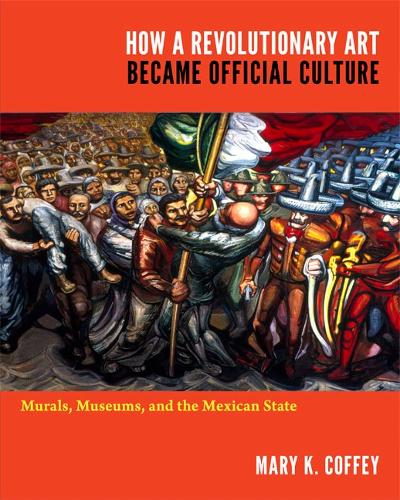
Книга How a Revolutionary Art Became Official Culture: Murals, Museums, and the Mexican State
This is a study of the reciprocal relationship between Mexican muralism and the three major Mexican museums--the Palace of Fine Arts, the National History Museum, and the National Anthropology Museum. Mary Coffey traces the transformation of Mexican muralism from a public art with radical social intentions to a form of state propaganda. There are three chapters, one for each museum, beginning in 1934 with the renewal of state patronage and ending in 1968 with the massacre at Tlatelolco. Heavily illustrated, a subvention will enable us to publish the work in full color.
A public art movement initiated by the postrevolutionary state, Mexican muralism has long been admired for its depictions of popular struggle and social justice. Mary K. Coffey revises traditional accounts of Mexican muralism by describing how a radical art movement was transformed into official culture, ultimately becoming a tool of state propaganda. Analyzing the incorporation of mural art into Mexico's most important public museums—the Palace of Fine Arts, the National History Museum, and the National Anthropology Museum—Coffey illuminates the institutionalization of muralism and the political and aesthetic issues it raised. She focuses on the period between 1934, when José Clemente Orozco and Diego Rivera were commissioned to create murals in the Palace of Fine Arts, through the crisis of state authority in the 1960s. Coffey highlights a reciprocal relationship between Mexico's mural art and its museums. Muralism shaped exhibition practices, which affected the politics, aesthetics, and reception of mural art. Interpreting the iconography of Mexico's murals, she focuses on representations of mestizo identity, the preeminent symbol of postrevolutionary Mexico. Coffey argues that those gendered representations reveal a national culture project more invested in race and gender inequality than in race and class equality.
"“Readers from all disciplines will find here a sophisticated analysis of how, when, and where Mexico’s early twentieth-century artistic and political revolutions intersected and how, in becoming orthodoxy, they informed and were informed by museum spaces and practices.”" - Hispanic American Historical Review
"“[T]his book… addresses a fascinating topic and the reader is left in no doubt about the writer’s expertise in the matter of Mexican mural art…. This is a very valid and serious object of study, and Coffey provides a rich, nuanced understanding of the works that she examines – from the social realism and drama of José Clemente Orozco and Diego Rivera to the Bahaus abstraction of Mathias Goeritz.”" - Latin American Review of Books
"“Coffey’s text is a richly researched contribution to scholarship on muralism and Mexican nationalism. More generally, it will be important to scholars interested in the museum as a ritual of state formation and a discursive site of power.” " - Visual Studies
"“The study is academically rigorous and would appeal to specialists in the field of study, but it is also accessible to a wider readership interested in the relationship between visual culture and politics, Mexican art, and historical and political events in Mexico. This is an excellent contribution to the field, an informative and engagingly written book that balances analysis of mural works with illuminating reflections on their artistic, historical, and political contexts.”" - Modernism/modernity
"“Coffey is ultimately concerned with exploring how a so-called revolutionary art form helped promote the state-sponsored, post-revolutionary myths of homogeneity and modernity. ...[This text is] appropriate for advanced undergraduate and graduate level readers and are recommended for libraries supporting research on museum studies, modernism, and Latin American and Chicano art and history.”" - ARLIS/NA Reviews
"“Coffey’s book is to be recommended, not simply as an attractive, yet relatively inexpensive addition to the coffee table, but also as stimulating reading to those interested in Mexican art and museums and the way that both have been used by Mexico’s post-revolutionary governments to validate the Revolution, to formulate contemporary citizenship, to foster a patriotic sense of mexicanidad, and to ordain official history and culture.”" - Journal of Latin American Geography
"“How a Revolutionary Art Became Official Culture has the capacity to advance scholarship across several disciplines. Coffey’s extensive discourse on muralism, museums, indigenism, and national identity will appeal to scholars of visual anthropology, visual sociology, cultural studies, museum studies, and art history. The text would also be a suitable resource for advanced undergraduate or graduate courses emphasizing visual culture.” " - Visual Anthropology Review