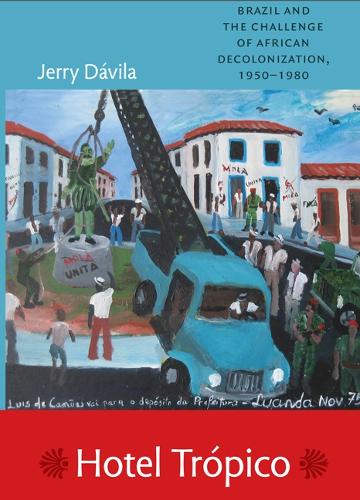
Книга Hotel Trópico: Brazil and the Challenge of African Decolonization, 1950–1980
The attempts by Brazilian diplomats and intellectuals to establish ties with Africa during and after decolonization reveal the contradictions in Brazil's idea of itself as a "racial democracy"
In the wake of African decolonization, Brazil attempted to forge connections with newly independent countries. In the early 1960s it launched an effort to establish diplomatic ties with Africa; in the 1970s it undertook trade campaigns to open African markets to Brazilian technology. Hotel Trópico reveals the perceptions, particularly regarding race, of the diplomats and intellectuals who traveled to Africa on Brazil’s behalf. Jerry Dávila analyzes how their actions were shaped by ideas of Brazil as an emerging world power, ready to expand its sphere of influence; of Africa as the natural place to assert that influence, given its historical slave-trade ties to Brazil; and of twentieth-century Brazil as a “racial democracy,” a uniquely harmonious mix of races and cultures. While the experiences of Brazilian policymakers and diplomats in Africa reflected the logic of racial democracy, they also exposed ruptures in this interpretation of Brazilian identity. Did Brazil share a “lusotropical” identity with Portugal and its African colonies, so that it was bound to support Portuguese colonialism at the expense of Brazil’s ties with African nations? Or was Brazil a country of “Africans of every color,” compelled to support decolonization in its role as a natural leader in the South Atlantic? Drawing on interviews with retired Brazilian diplomats and intellectuals, Dávila shows the Brazilian belief in racial democracy to be about not only race but also Portuguese ethnicity.
"“[T]his is a solidly researched and colourfully written study, and its broad geographical and thematic scope should appeal to a wide readership both within and beyond the confines of Afro- and Luso-Brazilian studies.”" - Journal of Latin American Studies
"“At a time when Brazil is garnering widespread attention as a global economic and geopolitical power, this book provides an indispensable historical framework to understand the conditions that have led to this status. Africa in fact served as a platform for Brazil to assert itself as an emerging world power in the 1960s. Dávila offers one of the most sophisticated and in-depth analyses of Brazil-Africa relations to date. One of the highlights of his book are the interviews, which capture quite vividly the complicated nexus among affect, culture, race, myth, desire, memory, and foreign policy.”" - American Historical Review
"“Jerry Dávila's insightful and very well-written book has arrived at an opportune moment. . . . The considerable strengths of Hotel Trópico rest on Dávila's solid prior scholarship on Brazil's race relations, unprecedented access to comparatively recent Brazilian diplomatic and Portuguese governmental archives, extended interviews with key players over five years, and broad institutional and collegial ties in several countries. The research is meticulous and copiously documented, the argumentation is skillful and clear, and the style is lively, detailed and almost novelistic in its narrative.”" - The Americas
"“This book is no standard diplomatic history. It falls within the genre of work—mostly related to the study of US foreign relations—that seeks to show how domestic race relations have left a profound mark on the conduct of foreign policy. . . . [A] well-written and insightful book. . . .”" - International Affairs