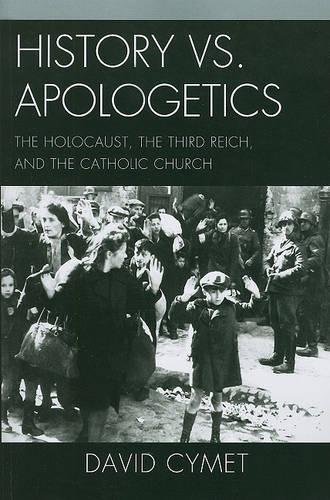
Книга History vs. Apologetics: The Holocaust, the Third Reich, and the Catholic Church
Set within the context of the political and ideological developments of the time, History vs. Apologetics examines the role played by the Catholic Church in the rise and consolidation of the Third Reich and in particular with regard to the Nazi persecution of the Jews. Distanced in the beginning, the Catholic Church and the Nazi party drew closer as Hitler's popularity increased. At the ratification of the Concordat in Rome, a commitment not to interfere with the Nazis' 'Final Solution' to the 'Jewish Question' was traded for a verbal promise from Berlin to exclude the baptized converts. While the Nazi government violated the Concordat at every turn, the Church kept zealously its promise. Pope Pius XII never mentioned the persecuted Jews by name and denied any knowledge of the annihilation of the Jews. Even after the war, Pius XII refused to condemn anti-Semitism and Germany's role in the Holocaust. Instead, the Vatican engaged in the protection of genocide perpetrators and assisted in their mass escape. David Cymet's comprehensive critical analysis of the polemical literature on the topic makes it possible to separate legitimate history from apologetic allegations and misrepresentations, bringing to light key elements of Church policy that is intentionally misinterpreted by apologists. By surveying the Church's policy from just before the rise of Nazism to the present, Cymet demonstrates how the Nazis were able to turn the Catholic Church into their ally in their war against the Jews.
"Cymet’s book . . . contains much more than just an analysis of the Church’s role in that period. It is a complete history of the era, beginning with the years following World War I, the political turmoil that gave rise to the emergence of Nazi Germany, and how Hitler usurped the democratic process to enable himself to become dictator. It documents the plight of the Jews in all of the nations of Europe from the pre–World War II era until the liberation of the concentration camps. Each chapter is interlaced with the role the Catholic Church played in every European country affected by the Holocaust, as well as the Vatican’s postwar efforts to create escape routes for Nazi war criminals to South America. Its bibliography consists of more than 100 historical works and documents on the Holocaust era, richly annotated with footnotes at the end of each chapter. While Dr. Cymet drew mainly on existing and available sources for his research, putting all the puzzle pieces together was his foremost challenge in rejecting, 'politically correct' and revisionist interpretations of that era." - Mishpacha, September 2010
"A thoughtful and fascinating analysis of the alliance of Nazi Germany and the Catholic church, making for an enthusiastically recommended read and addition to community and college religion and history collections." - Midwest Book Review
"The author has produced a well-documented presentation of Christian anti-Semitism in the 20th century that facilitated the Shoah as well as the reform of anti-Jewish sentiment that took place after the death of Pope Pius XII. The book is divided into thirteen chapters that follow a chronological path of anti-Semitic statements by Catholic publications and bishops before the rise of the Third Reich, complicity in the policies of the Reich, and the compassion shown after the war toward perpetrators of Nazi crimes. The dilemma of Church authority between condemning Communism and remaining silent in the face of Nazi aggression, which was also anticommunist, is a common theme running through many of the chapters. The book concludes with a discussion of the acknowledgement by Pope John Paul II of the failure of Church authority during the Holocaust. This book is well suited for any library maintaining a collection including Holocaust studies." - Journal Of Nietzsche Studies, February/March 2011
"In the recent, impressively researched, History vs. Apologetics: The Holocaust, the Third Reich, and the Catholic Church, David Cymet observes that the Archbishop of Genoa, Giuseppe Cardinal Siri, with the help of Hudal and a Croatian priest named Krunoslav Stjepan Draganovic, aided in establishing the escape hatch in his own diocese." - COMMENTARY