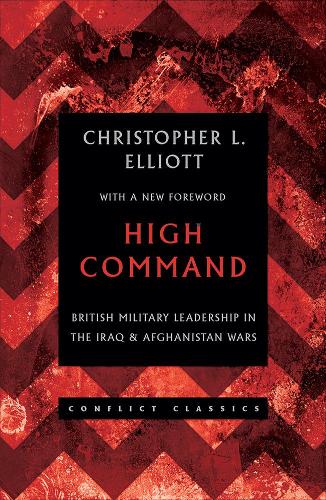
Книга High Command: British Military Leadership in the Iraq and Afghanistan Wars
** Includes a New Postcript 'The Chilcot Report—Early Thoughts on Military Matters'** From 2001 Britain supported the United States in wars in Iraq and Afghanistan. 'Victory' in such conflicts is always hard to gauge and domestic political backing for them was never robust. For this, the governments of Tony Blair and Gordon Brown were held responsible, and paid the price, but the role played by the High Command in the Ministry of Defence also bears examination. Critics have noted that the armed services were riven by internal rivalry and their leadership was dysfunctional, but the truth is more complicated. In his book Elliott explores the circumstances that led to these wars and how the Ministry of Defence coped with the challenges presented. He reveals how the Service Chiefs were set at odds by the system, almost as rivals in the making, with responsibility diffuse and authority ambiguous. The MoD concentrated on making things work, rather than questioning whether what they were being asked to do was practicable.
"Long overdue, 'High Command' is a study of what's wrong at the MoD, and an excellent primer for the Chilcot report. . . . Elliott sets out an agenda for reform as well as a narrative. He does so in terms that Evelyn Waugh could not have bettered." - The Spectator
"An outstanding book on British military leadership in the Iraq and Afghanistan wars." - Changing Character of War, Oxford University
"A very welcome present this Christmas was a copy of Major General (Retd) Christopher Elliott's book, 'High Command', about British Military Leadership in the Iraq and Afghanistan Wars. . . . An extremely well written and thoughtful book it examines the causes of these wars and how the Ministry of Defence coped with the challenges that they presented." - Salisbury Journal
"[Elliott] is meticulous in setting out . . . who was who in key military positions during this period, the structures within which they were working and, based on interviews, their opinions on how 'the system' worked . . . Also, commendably, he concludes with some practical suggestions as to how the system might be changed for the better." - Asian Affairs