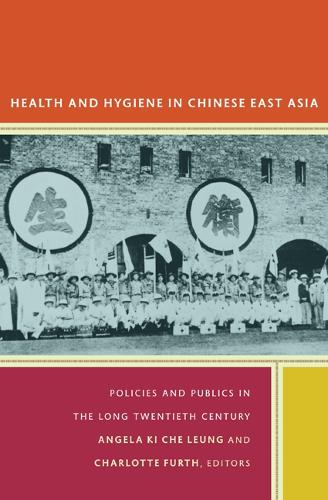
Книга Health and Hygiene in Chinese East Asia: Policies and Publics in the Long Twentieth Century
A collection exploring public health policies and implementation in Chinese regions of East Asia from the late nineteenth century to the present
This collection expands the history of colonial medicine and public health by exploring efforts to overcome disease and improve human health in Chinese regions of East Asia from the late nineteenth century to the present. The contributors consider the science and politics of public health policymaking and implementation in Taiwan, Manchuria, Hong Kong, and the Yangzi River delta, focusing mostly on towns and villages rather than cities. Whether discussing the resistance of lay midwives in colonial Taiwan to the Japanese campaign to replace them with experts in “scientific motherhood” or the reaction of British colonists in Shanghai to Chinese diet and health regimes, they illuminate the effects of foreign interventions and influences on particular situations and localities. They discuss responses to epidemics from the plague in early-twentieth-century Manchuria to SARS in southern China, Singapore, and Taiwan, but they also emphasize that public health is not just about epidemic crises. As essays on marsh drainage in Taiwan, the enforcement of sanitary ordinances in Shanghai, and vaccination drives in Manchuria show, throughout the twentieth century public health bureaucracies have primarily been engaged in the mundane activities of education, prevention, and monitoring.
Contributors. Warwick Anderson, Charlotte Furth, Marta E. Hanson, Sean Hsiang-lin Lei, Angela Ki Che Leung, Shang-Jen Li, Yushang Li, Yi-Ping Lin, Shiyung Liu, Ruth Rogaski, Yen-Fen Tseng, Chia-ling Wu, Xinzhong Yu
"“[T]his book provides many solid case studies to examine the intersections between governments, culture and science. Anyone interested in the history of Chinese medicine, colonial medicine and public health in East Asia will find it helpful.”
" - China Review
"“This book should be of interest to scholars who want to see a more cosmopolitan approach to the history of medicine. . . . This book departs from earlier scholarship on public health in East Asia in two important aspects. First is the shift in focus to geographical regions that are far from the center of state power, such as Manchuria and the Pearl River delta, as well as the focus on the countryside rather than urban centers. Second, studying the embedded local practices and traditions and their interactions with international and transnational influences allow the authors to break out of the narrative based on imperialism or nation-building as the shaper of public health.”" - Bulletin of the History of Medicine
"“This timely and diverse volume brings together exemplary scholarship on the history of colonial medicine and public health in China and Taiwan from the late nineteenth century to the present. . . . [T]his invaluable volume commands not only the attention of East Asianists, but all scholars interested in the global circulations of scientific knowledge, medical technologies, and practices of governance.”" - Journal of Asian Studies
"“This volume skillfully highlights the importance of a holistic view of medicine and an understanding of the ‘web of biological relationships’ between humans and the environment in managing and understanding disease and health (271).”" - Johnson Journal of Interdisciplinary History
"“This volume, edited by Angela Ki Che Leung and Charlotte Furth, exemplifies the diverse social science approaches at work in the study of medical/health history. The book offers a fascinating investigation of the health and hygiene developments in twentieth-century Chinese East Asia, with insightful findings.”" - Social History of Medicine