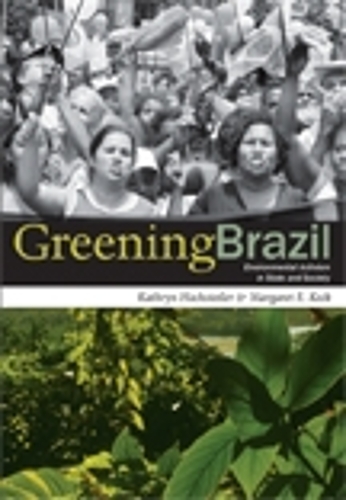
Книга Greening Brazil: Environmental Activism in State and Society
Authoritative work on the complex history of modern Brazilian environmental policy.
Greening Brazil challenges the claim that environmentalism came to Brazil from abroad. Two political scientists, Kathryn Hochstetler and Margaret E. Keck, retell the story of environmentalism in Brazil from the inside out, analyzing the extensive efforts within the country to save its natural environment, and the interplay of those efforts with transnational environmentalism. The authors trace Brazil’s complex environmental politics as they have unfolded over time, from their mid-twentieth-century conservationist beginnings to the contemporary development of a distinctive socio-environmentalism meant to address ecological destruction and social injustice simultaneously. Hochstetler and Keck argue that explanations of Brazilian environmentalism—and environmentalism in the global South generally—must take into account the way that domestic political processes shape environmental reform efforts.
The authors present a multilevel analysis encompassing institutions and individuals within the government—at national, state, and local levels—as well as the activists, interest groups, and nongovernmental organizations that operate outside formal political channels. They emphasize the importance of networks linking committed actors in the government bureaucracy with activists in civil society. Portraying a gradual process marked by periods of rapid advance, Hochstetler and Keck show how political opportunities have arisen from major political transformations such as the transition to democracy and from critical events, including the well-publicized murders of environmental activists in 1988 and 2004. Rather than view foreign governments and organizations as the instigators of environmental policy change in Brazil, the authors point to their importance at key moments as sources of leverage and support.
"“Greening Brazil is a superb analysis of the growth of the Brazilian environmental movement since the 1950s. The authors bring to the task a sophisticated understanding of Brazilian politics and a deep knowledge of international trends in environmental politics. Greening Brazil is the most satisfying account yet written of any environmental movement outside of Europe and the United States.”" - Latin American Politics and Society
"“Greening Brazil is a vital contribution for readers interested in the development of social environmentalism in Brazil, as well as the recent rise in environmental politics in Brazil and Latin America. Kathryn Hochstetler and Margaret Keck . . . produce a persuasive view of the social, institutional, and governmental interactions that have shaped governance of the environmental movement and politics in Brazil. . . . It should be seen as a pioneering book in the field, hopefully encouraging more research on the subject.”" - Canadian Journal of History
"“Greening Brazil, a breakthrough book, makes an outstanding contribution to this puzzle. It demonstrates how small agencies in low salience issue areas confronting powerful detractors survive, expand and make a difference. Kathryn Hochstetler and Margaret Keck persuasively argue that extensive interpersonal and professional networks carefully cultivated by key leaders, along with their finely honed discernment over which battles to fight and how to fight them, are the key explanatory factors. . . . Moreover, the book is a vivid example of how to advance knowledge, informed by theory, on the real workings of Latin American institutions beyond deductive analyses of pathologies in institutional design followed by prescriptions on how to fix them.”" - Journal of Latin American Studies