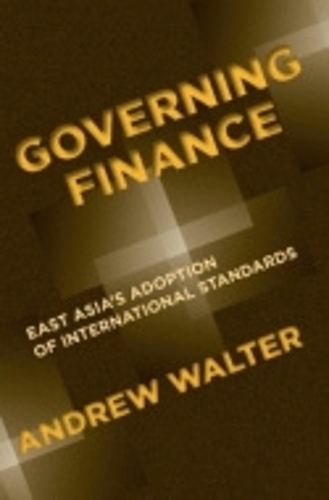
Книга Governing Finance: East Asia's Adoption of International Standards
The international financial community blamed the Asian crisis of 1997–1998 on deep failures of domestic financial governance. To avoid similar crises in the future, this community adopted and promoted a set of international "best practice" standards of financial governance. The G7 asked specialized public and private sector bodies to set international standards, and tasked the International Monetary Fund and the World Bank with their global dissemination. Non-Western countries were thereby encouraged to emulate Western practices in banking and securities supervision, corporate governance, financial disclosure, and policy transparency.
In Governing Finance, Andrew Walter explains why Indonesia, Malaysia, South Korea, and Thailand—key targets and test cases of this international standards project—were placed under intense pressure to transform their domestic financial governance. Walter finds that the depth of the economic crisis, and more enduring aspects of Asian capitalism, such as family ownership of firms, made substantive compliance with international standards very costly for the private sector and politically difficult for governments to achieve. In spite of international compliance pressure, the result was varying degrees of cosmetic or "mock" compliance. In a book containing lessons for any agency or country attempting to implement lasting change in financial governance, Walter emphasizes the limits of global regulatory convergence in the absence of support from domestic politicians, institutions, and firms.
The international financial community blamed the Asian crisis of 1997–1998 on deep failures of domestic financial governance. To avoid similar crises in the future, this community adopted and promoted a set of international "best practice" standards of financial governance. The G7 asked specialized public and private sector bodies to set international standards, and tasked the International Monetary Fund and the World Bank with their global dissemination. Non-Western countries were thereby encouraged to emulate Western practices in banking and securities supervision, corporate governance, financial disclosure, and policy transparency.
In Governing Finance, Andrew Walter explains why Indonesia, Malaysia, South Korea, and Thailand—key targets and test cases of this international standards project—were placed under intense pressure to transform their domestic financial governance. Walter finds that the depth of the economic crisis, and more enduring aspects of Asian capitalism, such as family ownership of firms, made substantive compliance with international standards very costly for the private sector and politically difficult for governments to achieve. In spite of international compliance pressure, the result was varying degrees of cosmetic or "mock" compliance. In a book containing lessons for any agency or country attempting to implement lasting change in financial governance, Walter emphasizes the limits of global regulatory convergence in the absence of support from domestic politicians, institutions, and firms.