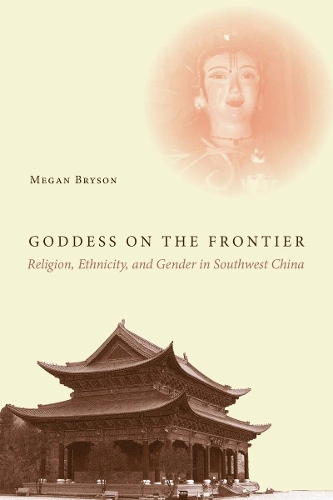
Книга Goddess on the Frontier: Religion, Ethnicity, and Gender in Southwest China
Dali is a small region on a high plateau in Southeast Asia. Its main deity, Baijie, has assumed several gendered forms throughout the area's history: Buddhist goddess, the mother of Dali's founder, a widowed martyr, and a village divinity. What accounts for so many different incarnations of a local deity?
Goddess on the Frontier argues that Dali's encounters with forces beyond region and nation have influenced the goddess's transformations. Dali sits at the cultural crossroads of Southeast Asia, India, and Tibet; it has been claimed by different countries but is currently part of Yunnan Province in Southwest China. Megan Bryson incorporates historical-textual studies, art history, and ethnography in her book to argue that Baijie provided a regional identity that enabled Dali to position itself geopolitically and historically. In doing so, Bryson provides a case study of how people craft local identities out of disparate cultural elements and how these local identities transform over time in relation to larger historical changes—including the increasing presence of the Chinese state.
"No other work has linked gendered religious symbols to the complex process of identity-making in such a long historical span, and with such analytical depth. Meticulously researched and lucidly written, this book makes an important and timely contribution to dialogues about religion, gender, and ethnicity in China." - George Washington University
"A compelling interdisciplinary study of a fascinating religio-cultural phenomenon on the frontiers of China, India, and Southeast Asia. Bryson has skillfully combined historical research with fieldwork to produce a methodologically sophisticated portrait of a regionally important goddess through her many historical and contemporary vicissitudes." - Vanderbilt University
"A tour de force of historical and ethnographic inquiry, Goddess on the Frontier sheds invaluable light on the religion and culture of southwest China. Combining meticulous scholarship with sophisticated theory, this book is a must-read for anyone interested in the interplay of gender, ethnicity, and religion." - Tel Aviv University
"Bryson hits her target well...The scholarship is excellent, the sources well researched, and the ancillary references useful." - Journal of Interdisciplinary History
"Megan Bryson's new book, Goddess on the Frontier: Religion, Ethnicity, and Gender in Southwest China, offers not only another example of the growing academic discourse on Dali, one of the most popular tourist destinations nowadays in Southwest China, but also an ingenuous case study of Baijie, an iconic figure in the cultural life of the Bai people in Dali....Clarifying, refreshing, and thought provoking, the book is a very layered analysis of Baijie." - Religion and the Arts
"[T]he author has successfully created a fascinating study of a Chinese frontier where histories, borders, cultures, religions, and ethnicities converge. Bryson has deftly combined historiography and art history with ethnography, and is thereby able to present before our eyes a sophisticated picture of a local goddess." - Nova Religio
"By employing such a thorough methodology, Bryson has compiled a volume of immense use to anyone in the field of Chinese religions, especially those seeking a window into the interaction of religion, ethnicity, and gender." - Religious Studies Review
"Goddess on the Frontier is an intellectual powerhouse....I wholeheartedly recommend the study for its depth of otherwise unavailable historical and anthropological information on the Dali region, for its potential strength in graduate training, and for its firm insistence that frontier regions of the Chinese heartland need to be studied on their own terms." - H-Buddhism