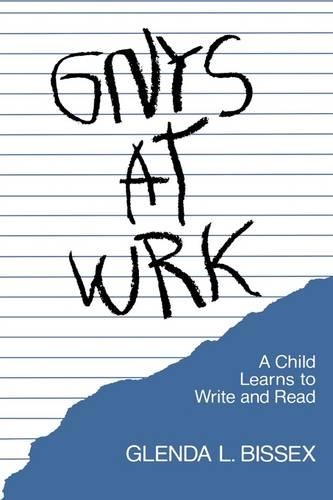
Книга Gnys at Wrk: A Child Learns to Write and Read
A fascinating drama of one little bo's acquisition of the first stage of literacy, with a scientific analysis of the underlying theories and research. -- Jeanne Chall (Harvard University) ...an exciting integrated account of developments that have almost always been studied in isolation from each other and over short periods. Bissex's observations, and her conclusions, are of educational as well as scientific importance. -- Charles Read (University of Wisconsin, Madison)
When he was five and a half years old, Paul Bissex wrote and posted this sign over his workbench: DO NAT DSTRB GNYS AT WRK. The “work” from which this “genius” refused to be “disturbed” was the work typical of all children, namely, the task of learning how to write and read. In Gnys at Wrk, Glenda Bissex goes far beyond the chronicle of her son’s accomplishment to provide the first in-depth case study of a child’s confrontation with written language, rich in revelations about the nature and processes of the mind.
Paul begins by writing notes in a system of his own invention—like IEAVGAWNTOOTHESTOR for “I have gone to the store”—and this system becomes more elaborate as he goes on to create stories, games and signs. Eventually, the system merges with conventional written English as Paul learns to separate words and to associate letters not with their names but with sets of possible sounds.
Glenda Bissex shows how the evolution of Paul’s writing ability is closely intertwined with his reading development—in Paul’s own words, “once you can write a word you can read it.“ She also makes an intriguing comparison between Paul’s schoolwork and his endeavors at home, and explores the influence of his personal interests and world view on his facility with words. Her study is a unique, detailed account of the “genius” that is, quite simply, the human capacity for language.
"This well-documented study is a first—a thorough and extensive case study of a child who ‘taught’ himself to read and write…before starting school. The book will be of peak interest to educators and researchers in psychology and linguistics who are as curious about written language development and the process of learning to write as they are curious about initial language acquisition and learning to read." - Contemporary Psychology
"Gnys at Wrk is eminently readable, admirably systematic, full of human interest and never sloppy; best of all, the conclusions of the study challenge many teachers’ most cherished beliefs and practices." - Times Higher Education Supplement
"An instructive, happily detailed record of learning to write and read, which finds educational implications for all children in the progress of one." - Kirkus Reviews