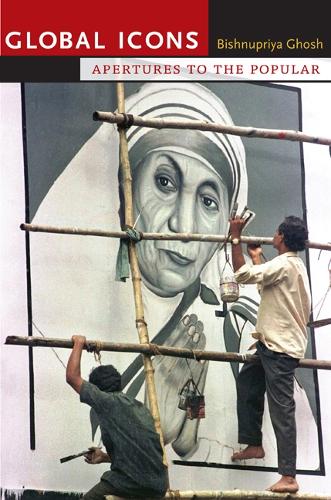
Книга Global Icons: Apertures to the Popular
Develops a materialist theory of global iconicity, taking into account the emotional and sensory responses that iconic figures elicit and the multiple modernities within which they are interpreted
A widely disseminated photograph of Phoolan Devi, India’s famous bandit queen, surrendering to police forces in 1983 became an emotional touchstone for Indians who saw the outlaw as a lower-caste folk hero. That affective response was reignited in 1994 with the release of a feature film based on Phoolan Devi’s life. Despite charges of murder, arson, and looting pending against her, the bandit queen was elected to India’s parliament in 1996. Bishnupriya Ghosh considers Phoolan Devi, as well as Mother Teresa and Arundhati Roy, the prize winning author turned environmental activist, to be global icons: highly visible public figures capable of galvanizing intense affect and sometimes even catalyzing social change. Ghosh develops a materialist theory of global iconicity, taking into account the emotional and sensory responses that these iconic figures elicit, the globalized mass media through which their images and life stories travel, and the multiple modernities within which they are interpreted. The collective aspirations embodied in figures such as Barack Obama, Eva Perón, and Princess Diana show that Ghosh’s theory applies not just in South Asia but around the world.
"“[A] pathbreaking book. . . .”" - The Hindu
"“Can global icons become driving forces of world historical transformation? Global Icons may not offer a definitive answer, but Bishnupriya Ghosh’s incisive reflections grant extraordinary insight into the popular runes of our time. Global Icons is therefore an invaluable guide to contemporary public culture and deserves a wide audience.”" - Indian Economic & Social History Review
"“The book of Ghosh is an endless source of discoveries and provocative thinking in the field of postcolonial studies and the way in which she continues to disclose throughout the whole book always new dimensions of the three examples studied is admirable, but beyond this discipline it offers also many innovative insights at the crossroads of star studies, audience studies, and critical theory. It offers an extremely valuable contribution to the study of the ‘life’ of icon.”" - Leonardo Reviews
"“The book will be of interest to scholars interested in media and cultural studies, and those interested in the ways in which iconic images become means for social groups to assert their aspirations.”" - Journal of Asian Studies
"“This book would be a useful read for students of semiotics, literature and the social sciences…. [An] original contribution.”" - Economic and Political Weekly
"[Global Icons] provides stimulating and important theoretical interrogations that help understand the social life and ‘cultural work’ of global icons.... This highly sophisticated book offers important theoretical insights and interesting material and will be of great interest to scholars studying visual culture, globalisation, media, popular culture, gender and post-colonial studies." - South Asia
"This highly sophisticated book offers important theoretical insights and interesting material and will be of great interest to scholars studying visual culture, globalisation, media, popular culture, gender and post-colonial studies." - Journal of South Asian Studies
"One cannot but be grateful for a book that establishes the rich liveliness of mass mediated figures and the multiple worlds that they come to inhabit." - Cultural Critique