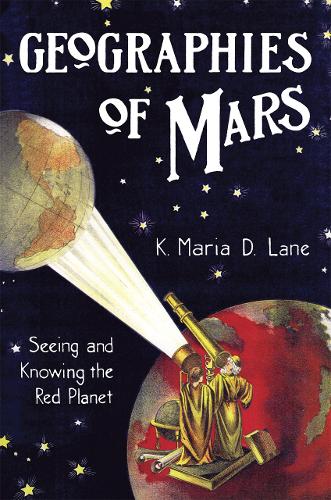
Книга Geographies of Mars: Seeing and Knowing the Red Planet
A highly original exploration of geography’s spatial dimensions at the beginning of the twentieth century, offering a new view of the mapping of far-off worlds.
One of the first maps of Mars, published by an Italian astronomer in 1877, with its pattern of canals, fueled belief in intelligent life forms on the distant red planet—a hope that continued into the 1960s. Although the Martian canals have long since been dismissed as a famous error in the history of science, K. Maria D. Lane argues that there was nothing accidental about these early interpretations. Indeed, she argues, the construction of Mars as an incomprehensibly complex and engineered world both reflected and challenged dominant geopolitical themes during a time of major cultural, intellectual, political, and economic transition in the Western world.
Geographies of Mars telescopes in on a critical period in the development of the geographical imagination, when European imperialism was at its zenith and American expansionism had begun in earnest. Astronomers working in the new observatories of the American Southwest or in the remote heights of the South American Andes were inspired, Lane finds, by their own physical surroundings and used representations of the Earth’s arid landscapes to establish credibility for their observations of Mars. With this simple shift to the geographer’s point of view, Lane deftly explains some of the most perplexing stances on Mars taken by familiar protagonists such as Percival Lowell, Alfred Russel Wallace, and Lester Frank Ward.
"“An exceptionally well-written and cleverly crafted exposition of what both speculative and mainstream science had to say in the late nineteenth and early twentieth centuries about the nature of Mars and the beings that might inhabit it. . . . The book is a must-read for any historian or scientist who cares about what, how, and why, and to what extent, cultural forces shape both scientific knowledge and public reaction to it.”" - American Scientist
"“Illuminating. . . . Altogether compelling. . . . [Geographies of Mars] paint[s] a vivid picture of Mars observation and the ways it has influenced and been influenced by contemporary culture and politics.”" - Times Literary Supplement
"Explore Mars as scientists and the public saw it around the beginning of the twentieth century, when canals on the Red Planet seemed a very real possibility." - Science News
"In the late nineteenth century, telescopic observations of Mars appeared to show artificially constructed channels across the planet's surface. These were christened 'canals,' and so began what some historians now call the 'canal craze,' with the scientific and popular press full of increasingly elaborate maps, and speculations about the height, intelligence and lifestyle of the aliens who lived on Mars and built these epic irrigation systems. (An excellent cultural history of this phenomenon is provided by Lane's book Geographies of Mars.)" - The Guardian
"Lane's book is surprising and often funny, as befits a recounting of this sort of wrongheadedness. It is, however, a serious account, well-researched, and well-illustrated, about how well-meaning people got Martian geography wrong. It explains how difficult it was for serious astronomers to correct the impression given by popularizers who had an attractive if erroneous picture of Mars (and of how science was done). As strange as the real Martian landscapes have turned out to be, to see them rightly we had to overcome the many sorts of geographic blinkers Lane has recounted." - The Dispatch
"Meticulously researched. . . . After the Viking Mars landers failed to detect life in the late 1970s, geneticist Norman Horowitz cautioned that the seductive idea that life could have started on Mars means we should take care in interpreting new findings and presenting them to the public. Lane's book reminds us that is still good advice." - Nature
"Some historians attribute the belief that the Red Planet was inhabited by intelligent beings to mistranslation of the Italian word canali to 'canals' in English—the latter conveying artificiality. But Lane maintains the notion sprang mainly from Schiaparelli’s maps themselves. 'It’s a cartographic process that I think is really influential,' she says. 'Once you saw these linear features—that’s what convinced people that they were probably canals.'" - The Scientist
"“We no longer dream about Martians, but the lesson of Geographies of Mars is still timely: science may be the search for truth, but the way we think and talk about science is a product of our hopes, fears, and dreams.”" - Barnes and Noble Review
"Lane offers a most unusual view of a well-known episode in astronomy. . . . There is a lesson here for artists, astronomers, social scientists and journalists. Lane's ‘geographer's gaze’ is particularly relevant to the last two categories." - Imago Mundi
"“Lane has done her homework, immersing herself in the primary and secondary literature; and yes, she has definitely made a major contribution to the discussion. . . . I urge historians of astronomy and of Victorian science to read Geographies of Mars and to consider its conclusions carefully.”" - Isis
"“A methodical examination of the social production of geographical knowledge in particular places and relational spaces. For a scholar interested in the geography of science and the science of geography, the book—drawing on critical cartography, science and technology studies, the geopolitics of empire, and the history of geography—will not fail to illuminate.”" - Cultural Geographies
"“Lane, informed by her sensibilities as a historical geographer, brings us a fresh take. . . . In this fascinating book she eschews the argument that the story can be adequately explained as misguided observations by a few rogue astronomers and instead enlightens our understanding through the lens of geography."" - Journal for the History of Astronomy
"Lane makes plain that late nineteenth-century Mars observers suffered from a kind of 'geography envy' and used geographical techniques to meet the challenge of moving knowledge about Mars securely and efficiently between places and to different kinds of audiences." - Historical Studies in the Natural Sciences
"Lane's Geographies of Mars brings to this fruitful mix of literary and historical scholarship a fresh geographical perspective, and represents the most impressive interdisciplinary study of Mars yet. The book breaks a great deal of new ground and is exemplary of how the ‘geographical turn’ can reinvigorate well-studied episodes within history of science. . . . Lane's geographical perspective impressively enhances our understanding of the Mars canal saga." - The British Journal for the History of Science