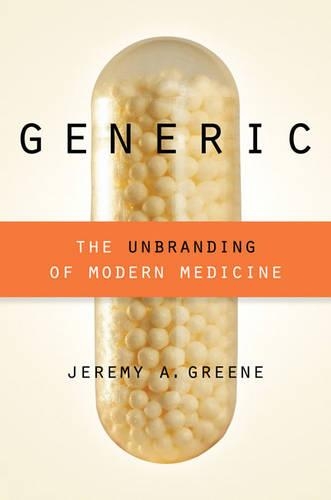
Книга Generic: The Unbranding of Modern Medicine
An enlightening and passionately written work, Generic opens the 'black box' of the pharmaceutical world. This book will deeply impact the way we imagine and practice medicine in the future. -- Siddhartha Mukherjee, Assistant Professor of Medicine, Columbia University, author of The Emperor of All Maladies: A Biography of Cancer An extraordinarily timely and important contribution to our understanding of health practice and public policy. The status of generics is a significant subject in itself, and also a tool to think with, linking physiology and policy, business history and clinical options. Generic is a book that should be read by anyone with a serious interest in contemporary health care. -- Charles E. Rosenberg, Professor of the History of Science and the Ernest E. Monrad Professor in the Social Sciences, Harvard University Jeremy Greene brings his knowledge and wisdom as both historian and physician to bear on the economics and politics of branding, marketing, and consumerism in health care. Most intriguingly, he asks fundamental questions about what it means to say one drug is the same as another. Fascinating and eye-opening. -- Susan Strasser, Richards Professor of American History, University of Delaware, author of Satisfaction Guaranteed: The Making of the American Mass Market Generic is a gem. Original, multi-layered, and powerfully narrated, the book unearths the history and value of generic drugs. While illuminating the dynamic interface of medicine, public health, and the marketplace in the US and beyond, Greene has crafted a vital compass that can greatly help us to understand and navigate the pharmaceutical present. -- Joao Biehl, Susan Dod Brown Professor of Anthropology, Princeton University, author of Will to Live: AIDS Therapies and the Politics of Survival The story of generic drugs is rife with intrigue, deceit, complex scientific debate, legislative wrangling, backstabbing, internecine warfare among health professions and government regulators, under-the-table deals worth billions of dollars, headline-grabbing prison sentences for trusted officials, and power struggles among monied interest groups. But Jeremy A. Greene's Generic is not just a lurid story: it is also rich with lessons in the negotiating of health policy, the brokering of legitimate scientific disputes to craft the best possible regulatory decisions for the public health, the struggles to make health care more affordable for as many citizens as possible, and the transformation of the global pharmaceutical marketplace. A provocative, thoughtful, and comprehensive look into an industry that took on big pharma and organized medicine. -- John P. Swann, author of Academic Scientists and the Pharmaceutical Industry: Cooperative Research in Twentieth-Century America
Generic drugs are now familiar objects in clinics, drugstores, and households around the world. We like to think of these tablets, capsules, patches, and ointments as interchangeable with their brand-name counterparts: why pay more for the same? And yet they are not quite the same. They differ in price, in place of origin, in color, shape, and size, in the dyes, binders, fillers, and coatings used, and in a host of other ways. Claims of generic equivalence, as physician-historian Jeremy Greene reveals in this gripping narrative, are never based on being identical to the original drug in all respects, but in being the same in all ways that matter. How do we know what parts of a pill really matter? Decisions about which differences are significant and which are trivial in the world of therapeutics are not resolved by simple chemical or biological assays alone. As Greene reveals in this fascinating account, questions of therapeutic similarity and difference are also always questions of pharmacology and physiology, of economics and politics, of morality and belief. Generic is the first book to chronicle the social, political, and cultural history of generic drugs in America. It narrates the evolution of the generic drug industry from a set of mid-twentieth-century "schlock houses" and "counterfeiters" into an agile and surprisingly powerful set of multinational corporations in the early twenty-first century. The substitution of bioequivalent generic drugs for more expensive brand-name products is a rare success story in a field of failed attempts to deliver equivalent value in health care for a lower price. Greene's history sheds light on the controversies shadowing the success of generics: problems with the generalizability of medical knowledge, the fragile role of science in public policy, and the increasing role of industry, marketing, and consumer logics in late-twentieth-century and early twenty-first century health care.