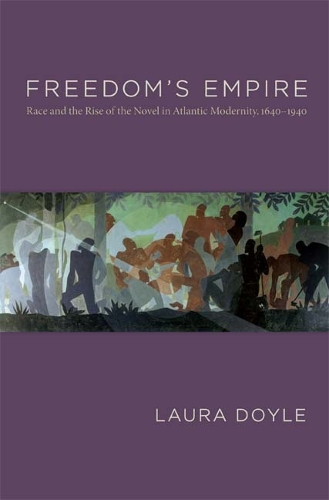
Книга Freedom's Empire: Race and the Rise of the Novel in Atlantic Modernity, 1640-1940
Major new history of the novel in English, showing how central interlocking notions of race and freedom have been to the genre over a 300 year period
In this pathbreaking work of scholarship, Laura Doyle reveals the central, formative role of race in the development of a transnational, English-language literature over three centuries. Identifying a recurring freedom plot organized around an Atlantic Ocean crossing, Doyle shows how this plot structures the texts of both African-Atlantic and Anglo-Atlantic writers and how it takes shape by way of submerged intertextual exchanges between the two traditions. For Anglo-Atlantic writers, Doyle locates the origins of this narrative in the seventeenth century. She argues that members of Parliament, religious refugees, and new Atlantic merchants together generated a racial rhetoric by which the English fashioned themselves as a “native,” “freedom-loving,” “Anglo-Saxon” people struggling against a tyrannical foreign king. Stories of a near ruinous yet triumphant Atlantic passage to freedom came to provide the narrative expression of this heroic Anglo-Saxon identity—in novels, memoirs, pamphlets, and national histories. At the same time, as Doyle traces through figures such as Friday in Robinson Crusoe, and through gothic and seduction narratives of ruin and captivity, these texts covertly register, distort, or appropriate the black Atlantic experience. African-Atlantic authors seize back the freedom plot, placing their agency at the origin of both their own and whites’ survival on the Atlantic. They also shrewdly expose the ways that their narratives have been “framed” by the Anglo-Atlantic tradition, even though their labor has provided the enabling condition for that tradition.
Doyle brings together authors often separated by nation, race, and period, including Aphra Behn, Eliza Haywood, Olaudah Equiano, Nathaniel Hawthorne, Harriet Wilson, Pauline Hopkins, George Eliot, and Nella Larsen. In so doing, she reassesses the strategies of early women novelists, reinterprets the significance of rape and incest in the novel, and measures the power of race in the modern English-language imagination.
"“Freedom’s Empire offers a unique perspective on Atlantic modernity. . . . Doyle shows that challenging the prevailing structures of literary criticism is imperative to a more nuanced understanding of what in an earlier collection Doyle termed ‘geomodernisms’. . . . Doyle’s study succeeds in its argument. . . . Impressively written and wide in scope, Freedom’s Empire shows persuasively how ‘novels and histories became partners in the project of narrativizing racial liberty.’”" - African American Review
"“Freedom's Empire is the most ambitious study of the novel and empire since Edward Said's Culture and Imperialism. . . . Freedom's Empire is a provocative history of the simultaneous articulation of race, freedom and empire in English-language literary and political practice.”" - Journal of Colonialism & Colonial History
"“[I]nvigorate[s] the Atlantic as a category of literary and cultural study in the West. In an effort to reconceptualize the abstract idea of freedom in the Atlantic world, Doyle demonstrates something fundamental to modern liberty—that at its foundation, it is a race myth. . . . Freedom’s Empire generates crucial questions and insights that substantively complicate the intellectual invention of Atlantic modernity and its literary history.”" - American Literature
"“Laura Doyle’s project in Freedom’s Empire is nothing short of upending the ways in which we have grown accustomed to reading, writing, and talking about the development of the English-language novel. It is an ambitious project, to say the least, and yet one in which Doyle is entirely successful. This is one of the most exciting literary studies’ interventions I have encountered in a long time, and my guess is that it will further alter the way in which we think about the seemingly discrete categories of the British and American novel. . . . This is a remarkable book, one that I would encourage any scholar of the novel in English to make space for on his or her bookshelf.”" - Rocky Mountain Review