Книга Forced Confrontation: The Politics of Dead Bodies in Germany at the End of World War II
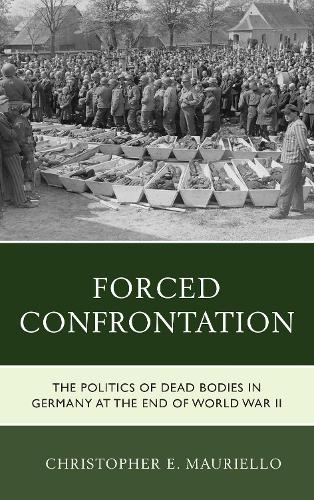
During the final weeks of World War II, the American army discovered multiple atrocity sites and mass graves containing the dead bodies of Jews, slave laborers, POWs and other victims of Nazi genocide and mass murder. Instead of simply reburying these victims, American Military Government carried out a series of highly ritualized “forced confrontations” towards German civilians centered on the dead bodies themselves. The Americans forced nearby German townspeople to witness the atrocity site, disinter the bodies, place them in coffins, parade these bodies through the town and lay them to rest in town cemeteries. At the conclusion of the ceremony in the cemetery in the presence of dead bodies, the Americans accused the assembled German civilians and Germany as whole of collective guilt for the crimes of the Nazi regime. This landmark study places American forced confrontations into the emerging field of dead body politics or necropolitics. Drawing on the theoretical work of Katherine Verdery and others, the book argues that forced confrontation represented a politicization of dead bodies aimed at the ideological goals of accusing Germans and Germany of collective guilt for the war, Nazism and Nazi genocide. These were not top-down Allied policy decisions. Instead, they were initiated and carried out at the field command level and by ordinary U.S. field officers and soldiers appalled and angered by the level of violence and killing they discovered in small German towns in April and May 1945. This study of the experience of war and forced confrontations around dead bodies compels readers to rethink the nature of the American soldier fighting in Germany in 1945 and the evolution, practice and purpose of American political and ideological ideas of German collective guilt.
"Mauriello (Salem State Univ.) explores several critical episodes in the closing weeks of Germany’s defeat in 1945. US Third Army soldiers, pushing through eastern Bavaria along the Czech border, came across victims of the death march from the Flossenbürg concentration camp. Corpses dotted the landscape, victims of mass murder; some lay scattered along the countryside, while others were buried in shallow graves. Some locals knew of the victims, but many did not. Coming across this brutality altered US troops' perception of the region’s civilian population. In a very short time, Americans moved from seeing themselves as liberators to men dedicated to justice for the victims. Spontaneously, officers compelled village leaders and residents to view the remains where found, then to dig up the decayed corpses from shallow graves, build coffins, and rebury the dead with honor. In the process, public processions of the victims served as a vehicle to lecture the Germans on their own collective guilt. By the third week of these rituals, where soldiers often denied civilians the use of gloves or masks in handling the dead, a growing sense of victimization grew among the Germans. Resentment among villagers turned the Americans from liberators into occupiers who unjustly punished those whose only crime was to live under Nazi rule. Summing Up: Recommended. Graduate students/faculty." - CHOICE