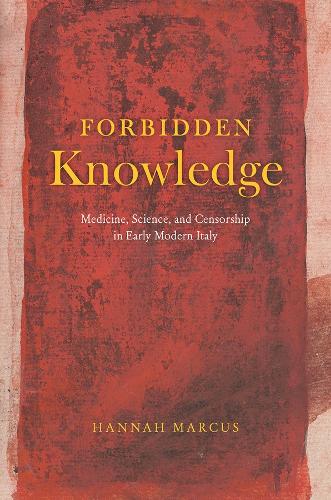
Книга Forbidden Knowledge: Medicine, Science, and Censorship in Early Modern Italy
An exploration of the censorship of medical books from their proliferation in print through the prohibitions placed on them during the Counter-Reformation.
Forbidden Knowledge explores the censorship of medical books from their proliferation in print through the prohibitions placed on them during the Counter-Reformation. How and why did books banned in Italy in the sixteenth century end up back on library shelves in the seventeenth? Historian Hannah Marcus uncovers how early modern physicians evaluated the utility of banned books and facilitated their continued circulation in conversation with Catholic authorities.
Through extensive archival research, Marcus highlights how talk of scientific utility, once thought to have begun during the Scientific Revolution, in fact, began earlier, emerging from ecclesiastical censorship and the desire to continue to use banned medical books. What’s more, this censorship in medicine, which preceded the Copernican debate in astronomy by sixty years, has had a lasting impact on how we talk about new and controversial developments in scientific knowledge. Beautiful illustrations accompany this masterful, timely book about the interplay between efforts at intellectual control and the utility of knowledge.
"“A remarkable book indeed, at once learned and engaging, well written and well conceived. It is also thoroughly researched. . . . Marcus provides us with a refreshing perspective on medicine, science, books, reading practices, professional self-definition, the discourse of utility, and the acquisition and dissemination of knowledge in early modern Italy. Her own book, which is well illustrated with thirty-six figures, is both illuminating and a pleasure to read.” " - Journal of Modern History
"Wonderful. . . . [The book] offers and provokes meditation on the timeless nature of censorship, its practices, its intentions and, perhaps especially, its (unintended) outcomes. . . . Forbidden Knowledge also makes an important intervention in the debate about Counter-Reformation Italy, still often represented as dominated by repressive Catholic institutions. Marcus' study of the censorship of medical texts reveals a much richer picture. . . . The book offers an invaluable meditation on the processes meant to distinguish good knowledge from bad, and the fluidity of those categories." - Times Higher Education
"Many years have passed since microhistory was the latest fashion in historiography, but [this] complex, extremely erudite, nuanced, and very carefully researched book by Hannah Marcus shows how its legacy is still with us, reinterpreted in creative and innovative ways. . . . This book, written with clarity, passion and erudition at the same time as being extremely well-researched, is a model of history writing and has the potential of becoming a classic." - Metascience
"Marcus expertly explores the mechanics and meaning of the censorship of medical writings in post-Tridentine Italy in this innovative and original study. . . . Forbidden Knowledge succeeds on multiple levels that allow for the revision of many assumptions about post-Tridentine intellectual activity. By providing details into the practices of expurgation and licensing, the book delineates the priorities of the Catholic Church, while demystifying censorship. . . . Additionally, she unveils the interests and priorities of the medical community in a manner that exceeds what is often found in traditional intellectual histories. . . . Most importantly, Marcus deftly explains the various contradictions that shaped the interactions between Catholic authorities and the medical and scientific communities of early modern Italy, showing how these dynamics defined the role of outside expertise in creating 'Catholic Knowledge' for centuries to come." - Annals of Science
"Throughout, Marcus expresses her insights in a very readable prose enriched by an excellent eye for telling anecdotes. . . . Marcus has provided an impressively researched book that makes several important contributions to understanding the application of Reformation-era Catholic censorship to the intellectual world of Italian learned medicine. There is much to draw on, and build on, in this book." - Social History of Medicine
"[A] meticulously researched study. . . . This monograph presents a series of powerful and convincing arguments about the shaping of both Catholic culture and scientific knowledge in the early modern period, but it is equally rich in material for scholars from different disciplinary and methodological viewpoints. Marcus deftly deploys the techniques and concerns of scholars who study the history of book production—collecting, material culture, literacy, and reading. In short, her work presents a compelling argument married to an innovative series of methodologies." - Journal of Interdisciplinary History
"This is an important study that all scholars and advanced students of early modern Europe will want to read, especially those interested in early modern medicine, religion, and the history of the book. . . . Highly recommended." - Choice
"Marcus provides a fresh perspective on the complex, often conflictual, relationship between religion and science in the Counter-Reformation age, illustrating the tortuous reception of prohibited medical texts in Catholic Italy." - Nuncius