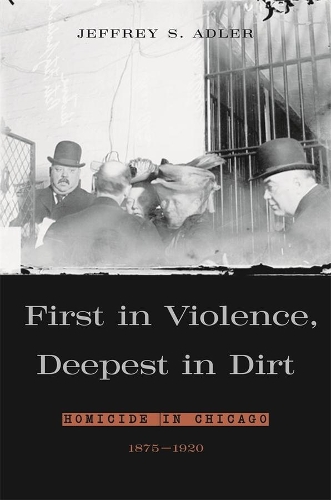
Книга First in Violence, Deepest in Dirt: Homicide in Chicago, 1875-1920
Between 1875 and 1920, Chicago's homicide rate more than quadrupled, making it the most violent major urban center in the United States--or, in the words of Lincoln Steffens, "first in violence, deepest in dirt." In many ways, however, Chicago became more orderly as it grew. Hundreds of thousands of newcomers poured into the city, yet levels of disorder fell and rates of drunkenness, brawling, and accidental death dropped. But if Chicagoans became less volatile and less impulsive, they also became more homicidal.
Based on an analysis of nearly six thousand homicide cases, First in Violence, Deepest in Dirt examines the ways in which industrialization, immigration, poverty, ethnic and racial conflict, and powerful cultural forces reshaped city life and generated soaring levels of lethal violence. Drawing on suicide notes, deathbed declarations, courtroom testimony, and commutation petitions, Jeffrey Adler reveals the pressures fueling murders in turn-of-the-century Chicago. During this era Chicagoans confronted social and cultural pressures powerful enough to trigger surging levels of spouse killing and fatal robberies. Homicide shifted from the swaggering rituals of plebeian masculinity into family life and then into street life.
From rage killers to the "Baby Bandit Quartet," Adler offers a dramatic portrait of Chicago during a period in which the characteristic elements of modern homicide in America emerged.
"Adler tells this story with verve. Someone is killed more than every second page, as 226 separate incidents draw the reader into this shifting culture of violence...In the end Adler's message is clear: Commerce and reckless driving aside, our streets and homes are safer when people don't have reason to fear their future financial stability, and men lose their obsession with the privileges and imperatives of manhood." - Chicago Tribune
"Fascinating reading...It's rather stunning to get a feel for how violence never really disappears, but instead continually shifts and adapts to its surroundings, whether those surroundings are the more rough-and-tumble nineteenth century or the more industrialized and efficient twentieth." - Bookslut.com
"[A] fascinating and important book." - American Historical Review
"Will our fascination with murder ever diminish? Unlikely, and Jeffrey S. Adler’s exploration of homicide in Chicago from 1875-1920 continues to whet our appetite for news, conclusions, speculations, and stories about homicides. First, let’s get one thing straight. This is a book about lives, not about deaths. One reason why we—the movie-going public, the readers of detective fiction and popular novels, criminologists, historians, and legal scholars—all love homicide, read about it, write about it, is because homicide reveals so much about people’s lives: homicides tell us about the lives of the victims, as split open by the event as their heads; the lives of the defendants, whose confessions or denials are accompanied by incriminating background information and speculation about who they were and why they did it; even the family members and the investigators are stripped naked for the gawking. This being said, this is not a salacious book, or an exploitative book. It is a scholarly treatment of homicide as one source, often the only source, of data about how people lived and died in a very interesting time and place, Chicago from 1875-1920." - Law and History Review
"Several factors combine to make this book rival Eric Monkkenon’s study of New York as the best history of big city homicide yet published. Start with Chicago in its explosively growing heyday, 1875–1920, its reputation for murderous violence unmatched; add numerous contemporary reports and studies; stir in some theoretical points scored for and against Norbert Elias and the Chicago School of Sociology; and throw in a juicy title from Lincoln Steffens. But the key ingredient is an unmatched collection of primary sources, led by nearly 6,000 detailed police reports, which allow Jeffrey Adler to exercise his interpretative skills with more subtlety and precision than any previous researcher." - Urban History