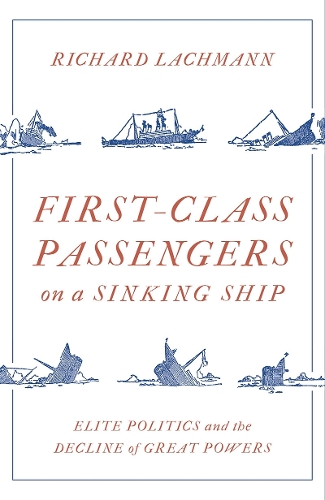
Книга First-Class Passengers on a Sinking Ship: Elite Politics and the Decline of Great Powers
How all great powers decline-including the US
The extent and irreversibility of US decline is becoming ever more obvious as America loses war after war and as one industry after another loses its technological edge. Lachmann explains why the United States will not be able to sustain its global dominance. He contrasts America's relatively brief period of hegemony with the Netherlands' similarly short primacy and Britain's far longer era of leadership.
Decline in all those cases was not inevitable and did not respond to global capitalist cycles. Rather, decline is the product of elites' success in grabbing control of resources and governmental powers. Not only are ordinary people harmed, but also capitalists become increasingly unable to coordinate their interests and adopt policies and make investments necessary to counter economic and geopolitical competitors elsewhere in the world.
Conflicts among elites and challenges by non-elites determine the timing and mould the contours of decline. Lachmann traces the transformation of US politics from an era of elite consensus to present-day paralysis combined with neoliberal plunder, explains the paradox of an American military with an unprecedented technological edge unable to subdue even the weakest enemies, and the consequences of finance's cannibalisation of the US economy.
"Praise for Capitalists In Spite of Themselves: Elite Conflict and Economic Transitions in Early Modern Europe (Oxford, 2000):
Received 2003 Distinguished Scholarly Publication Award (i.e. best book of the year) of the American Sociological Association." - American Sociological Association
"Praise for Capitalists In Spite of Themselves: Elite Conflict and Economic Transitions in Early Modern Europe (Oxford, 2000):
The volume is an exemplar of comparative analysis. Lachmann's work is an excellent recent treatment of the transition to capitalism." - American Journal of Sociology
"Praise for Capitalists In Spite of Themselves: Elite Conflict and Economic Transitions in Early Modern Europe (Oxford, 2000):
Lachmann's analysis of historical economic change is astute and pathbreaking. Empirically, this is comparative historical sociology at its best. An important book that is essential reading for those interested in understanding social change." - Contemporary Sociology
"Praise for Capitalists In Spite of Themselves: Elite Conflict and Economic Transitions in Early Modern Europe (Oxford, 2000):
Capitalists in Spite of Themselves synthesizes and extends elite theory and Marxian class analysis in a remarkably inventive way. Capitalists in Spite of Themselves is historically rich, theoretically rigorous and architecturally elegant." - Trajectories
"Praise for Capitalists In Spite of Themselves: Elite Conflict and Economic Transitions in Early Modern Europe (Oxford, 2000):
Capitalists in Spite of Themselves is a major tour de force, which will lead scholars to think very differently than they have until now about the making of modern Europe." - Trajectories
"Praise for States and Power (Polity 2010):
This is an excellent book. It is all the more remarkable because in spite of its relative brevity (little more than 200 pp. of text) it addresses its theme in a manner characterized among other things by its scope. Lachmann's substantial and original book is also characterized by an exacting methodological approach." - Sociologica
"Praise for States and Power (Polity 2010):
States and Power provides a wonderful starting point for someone seeking to understand the development of states and political power. An entertaining and informative read." - Contemporary Sociology
"Praise for States and Power (Polity 2010):
Richard Lachmann provides the reader with a comprehensive sociological analysis of state formation from antiquity to modernity. This text is an excellent read and would certainly be of interest to individuals studying power, state formation, political sociology and nationalism." - Nations and Nationalism
"Praise for States and Power (Polity 2010):
A mini-classic, indispensible for those who are interested in the history and future of the nation-state and the international system. Essential." - Choice
"Praise for What Is Historical Sociology? (Polity, 2013):
Petitions for a sociology that takes social change as its central object." - Revue française de science politique
"This provocative and sobering indictment often hits its targets." - Publishers Weekly
"Masterful...Lachmann shows us that, far from being unique to the period of British denouement, the destructive pursuit of such narrow self-interest by elites has repeatedly caused the decline of great powers throughout historical capitalism." - Journal of World-Systems Research