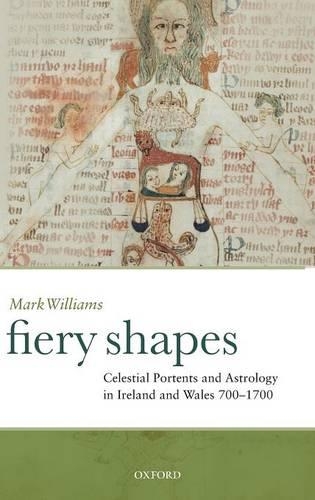
Книга Fiery Shapes: Celestial Portents and Astrology in Ireland and Wales 700-1700
The presentation of the magical and mantic in Celtic literature has persistently been dogged by misunderstanding and over-romanticized readings. Among the misconceptions about the ancient and medieval Celtic peoples, the notion of a specifically 'Celtic' astrology remains widespread in the popular mind. This study aims to counter such myth-making, and to demonstrate how a number Irish and Welsh literary writers in the medieval and Early Modern period conceived of portents in the heavens - comets, blood-coloured moons, darkened suns - and what they knew of the complex art of astrology. Early Irish churchmen felt that the end of the world was imminent, and this book explores the ways in which they saw signs in the heavens as evidence of impending apocalypse, and how they adapted such millenarian imagery for use in native sagas in Irish. It then moves on to an extended discussion of the cloud-divination ascribed to Irish druids in high medieval literary texts; this has sometimes naively been taken as evidence for the actual customs of the druidic caste, but it is shown here to be a development of the later Middle Ages, long after the druids' disappearance. Turning to Wales, the cosmological knowledge of two linked figures is scrutinized: the super-poet Taliesin, and King Arthur's prophet Merlin, whom Geoffrey of Monmouth represented in the mid 12th century as an astrological sage with a purpose-built observatory. Evidence for the knowledge of astrology amongst the learned poets of later medieval Wales is then laid out, with an analysis of a powerful late 15th century poem indicting the evil influence of the planet Saturn; such knowledge seems to have been largely medical in nature, and the book concludes with an examination of a number of Welsh astrological texts in manuscript, setting them against the longest astrological poem in a Celtic language, the mid 17th century Puritan mystic Morgan Llwyd's spiritualizing and evangelical 'Heavenly Science'.
"...an important contribution to an under-studied, and often marginalised, area of literary-historical study." - Marginalia
"Recommended for all university libraries and gives students and scholars of medieval literature and the history of science a good survey of the prevailing views and controversies of the fields without firmly resolving many of them except in a provisional way. It is also a potential gold mine for writers of medieval fantasy, since there is so much material with enormous lacunae to be filled in imaginatively." - Journal of the Fantastic in the Arts
"this is a well-produced, well-written work not only of professional scholarship but of love, for which both Mr Kenyon and his publishers can be congratulated." - Gerald Morgan, Welsh History Review
"Mark Williams has given us a new, serious, and painstaking study" - Andrew Breeze, Mediaevistik