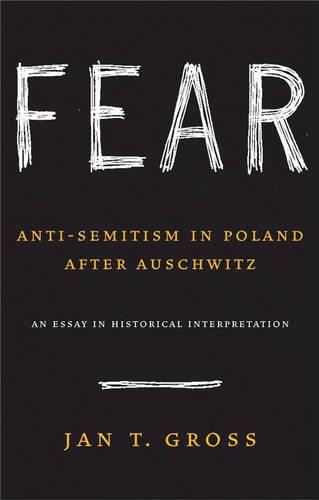
Книга Fear: Anti-Semitism in Poland after Auschwitz: An Essay in Historical Interpretation
Jan Gross's newest book, Fear, is a terrific piece of historical scholarship. Its primary focus is on the 1946 pogrom in Kielce, Poland, the worst case of anti-Jewish violence in postwar Europe. I remain shaken to the core by what he has related about Kielce and the violence that radiated out from the pogrom. Among the questions Gross asks are: How could it be that the persecution of the Jews continued after the Nazis were long gone? Why did the Jews need to flee Poland after the war? How was it that after the liberation those Poles who had protected and sheltered Jews were tormented by and afraid of their compatriots? Gross suggests that the answers lie in the nasty behavior of Poles toward the Jews during the war. It has to do with taking Jewish property and betraying Jewish Poles to the Nazis. The fear came from being faced with what they had done during the war; the surviving Jews reminded them of their recent rapacious and immoral past. Gross is a brilliant writer. There is never anything ponderous about his prose. It's clear and engaging, even if the stories he has to tell are terrifying. -- Norman Naimark, Hoover Institution Jan Gross's Fear is an extraordinary account and analysis of postwar Polish anti-Semitism. In many ways, this book is a sequel to Gross's celebrated Neighbors: The Destruction of the Jewish Community in Jedwabne, Poland. While Neighbors described and analyzed the assault by Polish citizens on their Jewish neighbors in the immediate aftermath of the German occupation of East Poland in the summer of 1941, Fear reconstructs and interprets physical and ideological attacks on Jews by Poles after Poland's liberation from the Nazis. But unlike the case of Jedwabne, here no one can argue about the presence or absence of German perpetrators. Anyone who reads this frightening account will realize the intensity and pervasiveness of anti-Jewish sentiments in postwar Polish society. This is a passionate yet well-documented, powerfully argued, and tightly controlled book. It is remarkable. -- Omer Bartov, Brown University
Poland suffered an exceedingly brutal Nazi occupation during the Second World War. Close to five million Poles were killed. Of these, more than half were Jews killed in the Holocaust. Ninety percent of the world's second largest Jewish community was annihilated. But despite the calamity shared by Poland's Jews and non-Jews, anti-Semitic violence did not stop in Poland with the end of the war. Jewish Holocaust survivors returning to their Polish hometowns after the war experienced widespread hostility, including murder, at the hands of their neighbors. The bloodiest peacetime pogrom in twentieth-century Europe took place in Kielce, Poland, a year after the war ended. Jan Gross's Fear is a detailed reconstruction of this pogrom and the Polish reactions to it that attempts to answer a perplexing question: How was anti-Semitism possible in Poland after the war? Gross argues that postwar Polish anti-Semitism cannot be understood simply as a continuation of prewar attitudes. Rather, it developed in the context of the Holocaust and the Communist takeover: Anti-Semitism eventually became a common currency between the Communist regime and a society filled with people who had participated in the Nazi campaign of murder and plunder, people for whom Jewish survivors were a standing reproach. The Polish poet Czeslaw Milosz said that Poland's Communist rulers fulfilled the dream of Polish nationalists by bringing into existence an ethnically pure state. For more than half a century, what happened to Jewish Holocaust survivors in Poland has been cloaked in guilt and shame. Writing with passion, brilliance, and fierce clarity, Gross at last brings the truth to light.