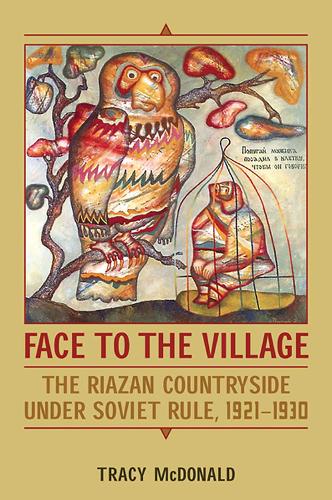
Книга Face to the Village: The Riazan Countryside under Soviet Rule, 1921-1930
'What sets Face to the Village apart from other studies of the Soviet countryside? Tracy McDonald provides engaging arguments on the loyalties of local officials and the practices of Soviet institutions, which she supports through extensive digging in local archives and an impressive grasp of the secondary literature. Face to the Village is filled with exceptionally colourful descriptions of local structures such as the courts and the police, and offers a unique entry into the dynamics of Soviet provinces in a time of ferment and upheaval.' -- Ben Eklof, Department of History, University of Indiana, Bloomington 'Face to the Village presents a portrait of the Soviet countryside that is not only rich with detail, but that also provides rare insight into the tensions that shaped collectivization. Tracy McDonald extends the scholarship on the late Imperial Russian peasantry into the early Soviet era in a way that has never been done before. The links she finds between the development of the soviets, local governments, and villages are absolutely fascinating.' -- Aaron Retish, Department of History, Wayne State University
In the summer of 1924, the Bolshevik Party called on scholars, the police, the courts, and state officials to turn their attention to the villages of Russia. The subsequent campaign to 'face the countryside' generated a wealth of intelligence that fed into the regime's sense of alarmed conviction that the countryside was a space outside Bolshevik control.
Richly rooted in archival sources, including local and central-level secret police reports, detailed cases of the local and provincial courts, government records, and newspaper reports, Face to the Village is a nuanced study of the everyday workings of the Russian village in the 1920s. Local-level officials emerge in Tracy McDonald's study as vital and pivotal historical actors, existing between the Party's expectations and peasant interests. McDonald's careful exposition of the relationships between the urban centre and the peasant countryside brings us closer to understanding the fateful decision to launch a frontal attack on the countryside in the fall of 1929 under the auspices of collectivization.
"‘Tracy McDonald's excellent book offers both authentic details and an illuminating set of important general conclusions drawn from close observation of a fascinating layer of rural experience in the early Soviet Union…. Face to the village will appeal to a broad array of students and scholars interested in early Soviet political and social history and peasant studies.’" - The Russian Review vol. 71:01:2012
"‘Tracy McDonald’s rich monograph focusses on transitions in village culture and relations between the state and local society in the 1920s in Riazan’ province…Face to the village is an illuminating examination of the still more Russian peasant dominated than Soviet controlled countryside of the 1920s.’" - Slavic Review, vol 71:02:2012
"
‘A thoughtful, penetrating, and important contribution to our understanding of the Soviet village during NEP ( New Economic Policy) and collectivization.’
" - American Historical Review vol 118:03:2013"‘This book presents a fascinating insight into the intricate world of the Central Russian peasant in the years before the violent imposition of collectivization… This engrossing study will be of great value to researchers and students interested in the relationship between state and society in the wake of tumultuous events and in understanding the world of the pre-collectivization Soviet peasantry.’" - Europe-Asia Studies vol 65:08:2013
"
‘Tracy McDonald’s book presents a fascinating insight into the intricate world of the Central Russian peasant in the years before the violent imposition of collectivization … the book is an engrossing study which will be of great value to researchers and students interested in the relationship between state and society in the wake of tumultuous events and in understanding the world of the pre-collectivization Soviet peasantry.’
" - Europe-Asia Studies"
‘This rich study has a great deal to say about the rural background to collectivization, and about the way that party leaders responded to, and were frustrated by, peasants’ actions and attitudes … This is a thoughtful, penetrating, and important contribution to our understanding of the Soviet village during NEP and collectivization.’
" - American Historical Review