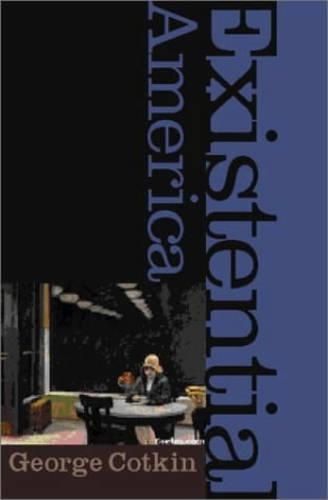
Книга Existential America
As a richly detailed account of the reception of existentialism in America, this book is unequaled. But it is more than the history of a particular philosophical movement. Cotkin explores the independent expressions of what he calls 'the Existentialist mood' in the work of Americans anticipating or paralleling the thought of European writers. Impeccable in its scholarship, Existential America is also a delight to read. The writing is lively and engaging and reveals, where appropriate, its author's ironic sense of humor. -- Hazel E. Barnes, American translator of Sartre's Being and Nothingness George Cotkin's Existential America is an outstanding new work. It is original in the best sense of the word, for no one has before examined how existentialism was received in the United States. The book is also compelling in its wide-ranging treatment of the academic accommodation of Sartre and the appropriation of his ideas by writers and artists. -- Bruce Kuklick, University of Pennsylvania, author of A History of Philosophy in America, 1720-2000 An excellent book by virtue of its breadth of approach. The author has aspired to do far more than write the history of existentialism in America. He uses the subject of existentialism, important enough in its own right, to give a fresh synthesis of much of American intellectual life in the second half of the twentieth century. -- James Hoopes, Babson College, author of Community Denied: The Wrong Turn of Pragmatic Liberalism
Europe's leading existential thinkers-Jean-Paul Sartre, Simone de Beauvoir, and Albert Camus-all felt that Americans were too self-confident and shallow to accept their philosophy of responsibility, choice, and the absurd. "There is no pessimism in America regarding human nature and social organization," Sartre remarked in 1950, while Beauvoir wrote that Americans had no "feeling for sin and for remorse" and Camus derided American materialism and optimism. Existentialism, however, enjoyed rapid, widespread, and enduring popularity among Americans. No less than their European counterparts, American intellectuals participated in the conversation of existentialism. In Existential America, historian George Cotkin argues that the existential approach to life, marked by vexing despair and dauntless commitment in the face of uncertainty, has deep American roots and helps to define the United States in the twentieth-century in ways that have never been fully realized or appreciated. As Cotkin shows, not only did Americans readily take to existentialism, but they were already heirs to a rich tradition of thinkers-from Jonathan Edwards and Herman Melville to Emily Dickinson and William James-who had wrestled with the problems of existence and the contingency of the world long before Sartre and his colleagues. After introducing this concept of an American existential tradition, Cotkin examines how formal existentialism first arrived in America in the 1930s through discussion of Kierkegaard and the early vogue among New York intellectuals for the works of Sartre, Beauvoir, and Camus. Cotkin then traces the evolution of existentialism in America: its adoption by Richard Wright and Ralph Ellison to help articulate the African-American experience; its expression in the works of Norman Mailer and photographer Robert Frank; its incorporation into the tenets of the feminist and radical student movements of the 1960s; and its lingering presence in contemporary American thought and popular culture, particularly in such films as Crimes and Misdemeanors, Fight Club and American Beauty. The only full-length study of existentialism in America, this highly engaging and original work provides an invaluable guide to the history of American culture since the end of the Second World War.