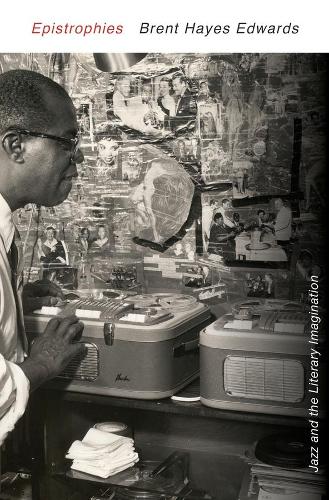
Книга Epistrophies: Jazz and the Literary Imagination
In 1941 Thelonious Monk and Kenny Clarke copyrighted “Epistrophy,” one of the best-known compositions of the bebop era. The song’s title refers to a literary device—the repetition of a word or phrase at the end of successive clauses—that is echoed in the construction of the melody. Written two decades later, Amiri Baraka’s poem “Epistrophe” alludes slyly to Monk’s tune. Whether it is composers finding formal inspiration in verse or a poet invoking the sound of music, hearing across media is the source of innovation in black art.
Epistrophies explores this fertile interface through case studies in jazz literature—both writings informed by music and the surprisingly large body of writing by jazz musicians themselves. From James Weldon Johnson’s vernacular transcriptions to Sun Ra’s liner note poems, from Henry Threadgill’s arresting song titles to Nathaniel Mackey’s “Song of the Andoumboulou,” there is an unending back-and-forth between music that hovers at the edge of language and writing that strives for the propulsive energy and melodic contours of music.
At times this results in art that gravitates into multiple media. In Duke Ellington’s “social significance” suites, or in the striking parallels between Louis Armstrong’s inventiveness as a singer and trumpeter on the one hand and his idiosyncratic creativity as a letter writer and collagist on the other, one encounters an aesthetic that takes up both literature and music as components of a unique—and uniquely African American—sphere of art-making and performance.
"Dazzling…[Edwards] compares the way poets use melody in language to the ways musicians use literary devices in jazz…[A] compellingly original perspective." - Publishers Weekly
"This is a brilliant and utterly arresting book that takes a surprisingly uncommon subject and looks at it in a profoundly original way." - Buffalo News
"[Edwards] exhibits what I can only call intellectual glamour. He joins syntax and sentiment with élan, demonstrating a charismatic brilliance that persuades in parallel with, as well as through, his argumentation and evidence…Hilarious and trenchant at once, Edwards would be a beguiling writer in any field…He’s that rare academic whose work demands attention outside of experts in the field, without sacrificing tone or complexity. Almost conspicuously, William Empson comes to mind…As an alternative aesthetic history, Epistrophies is immensely satisfying…What makes Epistrophies such a singular work is the vividness and rigor of Edwards’s storytelling. As with Coleman’s Skies of America, there exists a temptation to discuss Epistrophies for what it could have been. Nevertheless, there is brilliance." - The Nation
"Furnish[es] the reader with material that constantly surprises and subverts expectations." - PopMatters
"[Edwards] says something surprising and new that no one else has, or can, about two revered musicians [Mary Lou Williams and Cecil Taylor]—a genuine rarity in jazz scholarship…[The] critical and creative impulse to test the boundaries of the ‘sayable’ in both words and music—a ‘ferment at the horizon of articulacy’—is among the book’s guiding threads. In a brilliant chapter on the ‘poetics of transcription,’ Edwards studies the blues poem, a genre that has never found a happy home in either music or literature…Ambitiously, Edwards aims not just to hear, but to read, write, and think across a range of radically different sources. Epistrophies is a book whose individual parts persuade so easily and cohere so elegantly…The gift of Epistrophies is [an] act of renewal, an expansion not just of jazz literature as a category, but of jazz as a method." - Los Angeles Review of Books