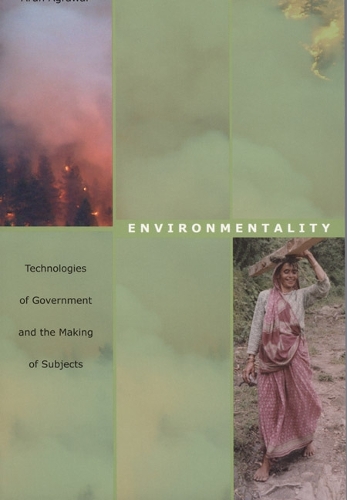
Книга Environmentality: Technologies of Government and the Making of Subjects
An investigation of environmental politics in light of Foucault's work, drawing on and extending work done in feminist environmentalism, political ecology, and common property scholarship, explains why villagers in the Kumaon Himalaya have begun to conserve forests.
In Kumaon in northern India, villagers set hundreds of forest fires in the early 1920s, protesting the colonial British state’s regulations to protect the environment. Yet by the 1990s, they had begun to conserve their forests carefully. In his innovative historical and political study, Arun Agrawal analyzes this striking transformation. He describes and explains the emergence of environmental identities and changes in state-locality relations and shows how the two are related. In so doing, he demonstrates that scholarship on common property, political ecology, and feminist environmentalism can be combined—in an approach he calls environmentality—to better understand changes in conservation efforts. Such an understanding is relevant far beyond Kumaon: local populations in more than fifty countries are engaged in similar efforts to protect their environmental resources.
Agrawal brings environment and development studies, new institutional economics, and Foucauldian theories of power and subjectivity to bear on his ethnographical and historical research. He visited nearly forty villages in Kumaon, where he assessed the state of village forests, interviewed hundreds of Kumaonis, and examined local records. Drawing on his extensive fieldwork and archival research, he shows how decentralization strategies change relations between states and localities, community decision makers and common residents, and individuals and the environment. In exploring these changes and their significance, Agrawal establishes that theories of environmental politics are enriched by attention to the interconnections between power, knowledge, institutions, and subjectivities.
"“Environmentality offers readers in the fields of anthropology, environmental studies, and history a useful and interesting case study. . . . Environmentality is an excellent piece of scholarship, and a valuable addition to the fields of environmental anthropology and history, as well as to the general literature on colonial and postcolonial India.”" - American Anthropologist
"[A] particularly useful and timely piece of scholarship as it attempts to transgress what are often distant and diverse literatures. This book helps to shed light on the connections between environmental regulation, practice and subjectivity. And in that way, this book illustrates the complexity and connectivity of environmental conflicts and struggles that are often overlooked by more limited or constrained analytical approaches. The book is very clearly organized and well written. . . ." - Rural Sociology
"Interesting. . . . The strength of the book lies in its exploration of agency among the local populations and the serious treatment of the culture that environmental regulation affects. . . . This book offers an insightful critique of the assumptions that both the state and peasant resistance are monolithic . . . and provides a useful starting point to understand the phenomena of community forestry that governments are implementing around the world." - American Historical Review