


Book Leonid Gorobets (set of 2 books)
This is an automatically translated description
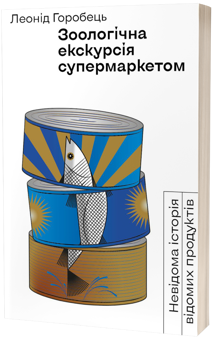
Book 1. Zoological Excursion by Supermarket
Oseledets is sardine, sardine is anchovy, anchovy is hamsa, hamsa is kilka, kilka is tulka, tulka is sprats, sprats is salaka, and salaka is oseledets. And oseledets is sardine...
Complicated? Only at first glance. Believe me, this series has an absolutely logical explanation. In his new book biologist Leonid Gorobets suggests that we take a walk to the nearest supermarket and find out why our cat has pork and shrimp, and not, say, elephant meat or moray.
Which animals are impossible to domesticate and why for this mission is better to turn cheetah than grizzly (if you really want to try something impossible)? Why are crab sticks made from what fish, why does farm chicken only increase sales in the shop, while farm salmon does not? Who ate less pork - the nobility or the villagers? Why should we not cook ostrich meat? Walking through the supermarket, the author moves in space and time, explaining the evolution of certain species. He tells you how to distinguish whether you are looking at real caviar, how to clean the fish properly, who are the trachichthys and whether "marmorovyjalovychina" is so tasty if you don't see its price tag.
Book 2. Follow the Broken Skull. A History of Skeletal Evolution
If you think that some organ appeared in the process of evolution of the skeleton, then you think. Or dreaming. Nothing new is taken. The way you and I, your pet cat or a chirping bird outside the window, are created to the very core is the result of millions of years of evolution.
All this in his book "Follow the broken skull. The history of skeletal evolution" is told by scientist Leonid Gorobets. He scrupulously goes through how the skeleton and bones changed, explaining on dinosaurs, humans and even fish how evolution worked all these years.
What is the gene "sleepy-eater", why do toads "withdraw" from the ribs and why crocodile meat tastes like chicken? Why are the eyes placed on the head and not, say, on the hands, and why are the ends really former swimmers? Which fish can overtake a cheetah in speed, and which finger would have to be amputated if we were moving like reptiles? Why octopus, despite their large brains, are often dumber than bjolis, and what is the difference between sharks and airplanes? The author of the book answers these and other questions, at times explaining why the internal skeleton is cooler than the external and how to distinguish a colleague from a reptiloid.
Leonid Gorobets - Doctor of Biological Sciences, works at the palaeontological department of the National Scientific and Natural Museum of the National Academy of Sciences of Ukraine. He is the author of the book "Follow the broken skull. The History of Skeleton Evolution".
Learns at the school Maybutni - IWonder and ACE school. Maintains a blog Stromata, where he talks about life, the universe and everything.