This is an automatically translated description
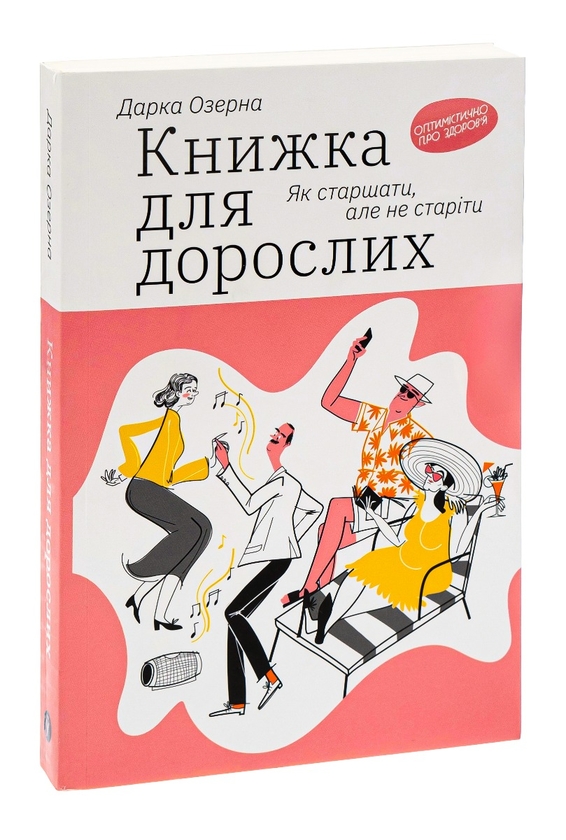
Realistically about getting older in Darka Ozerna's new book "A book for adults. How to grow older but not grow old", which became the third in the series "Optimistic about health".
In fact, in our information space, the life of all people over 35 is hardly noticeable. What do "adults" do? Is it true that older people are all sick, boring, outdated, don't want sex and don't like themselves in the mirror? No, it's not true. It's high time we reconsidered our attitudes to age, ageing, aging, and chronic illness. And not just to "stop being sick", but to understand what is happening to us, what are the risks and opportunities at each age, and to continue to grow older and not age.
"A book for adults. How to Grow Older Without Growing Older" will help you with this. It deals with factors that slow down or accelerate aging, prevention of cardiovascular disease and cancer, living with diabetes and lung and intestinal diseases, taking care of the body from the eyes to the bones, mental well-being, general and specific nutritional advice, menopause, erection, sex, and how to live happily ever after. Only without magic and magic pills.
Darka Ozerna, as always, easily, scientifically and evidence-based, with quotes from Oksana Zabuzhko, Yevhenia Kuznetsova, Serhiy Zhadan, Yuriy Izdryk, Patriarch Yuri Andrukhovych, Ivan Semesyuk and Les Podervyansky, gives answers to unexpected and provocative questions:
- Is there a basis in the meme about "a glass of water in old age" and what connection can there be between dehydration and delirium?
- Which wrinkles can be prevented and which ones can be smoothed out as you want?
- Why is it very good to be sweet cakes after seventy?
- Why is it worth giving your parents a few sex toys?
- Do crosswords save you from dementia?
- Why does a very old neighbour think you are a prostitute?
Why is giving a bottle of red wine sexy, but a box of chocolates is not?
The book is complemented by traditional illustrations by Olga Degtyareva.
Reviews of the book
Futurists say (well, not all of them, but Andriy Dligach definitely said on my show) that humanity is becoming more and more infantilised. And that's why it's more and more interesting to read about growing up and getting older. Especially if you find out that adult and older does not necessarily mean (as it turns out!) old and frail. And here is the most interesting thing (remember someone's "style of argument is more important than the subject of the argument"?) — it is important to me with what tone of voice I am told even the most interesting and important information for me. After all, often the science-pop that explains to a person how their biological machine works sins with a mentoring and condescending tone: "it's all about hormones," "you're all naive romantic fools, it's all about chemistry," "love is a disease," and so on... For me personally, such "intonation" prevents me from reading even the most interesting information. Daryna Ozerna - and this is felt in every line of this book - respects the simple and not obvious fact that living people are alive. And at the same time, he soberly and rationally "puts important things on the shelves" in an adult way. I think this is the secret of such a pleasant reading of this book. Enjoy it :)
Roman Kolyada, radio and TV presenter, composer, author of musical portraits of people
While reading this book, I felt relieved, which is a bit strange for a book with so many sad statistics. And yet this feeling does not leave me, because I read and hear an adult voice, devoid of the specific post-Soviet attempt to please everyone, to hide behind a pile of stunning quotes, to play it safe with a reference to authority, I hear intonations of inner freedom that you perceive as the norm in languages not crippled by secondary status, but which still strike you when you read non-fiction texts in Ukrainian. This is the inner freedom that only mastery of the entire range of the language-including anecdotes and table jokes, your own, modern, quotes and hints, jargon-gives you. It is an inner freedom that you notice because Daria Ozerna writes about the problems of society, such as alcoholism or the inability to cope with emotions and family troubles, without depersonalisation, up to personal examples. This is how you write in unashamed cultures, how you write when this society is really yours and you don't need anyone else's sanction to talk to it honestly.
Oksana Forostyna, publisher, writer, journalist
I used to think that at the age of 40, a person does not know what he or she lives for if he or she is not GREAT! And this, you see, does not shine for everyone. At 40, especially if you're a woman, you are virtually non-existent. The moment when you are not noticed both from space and here on earth. Who is there?
But now I'm 48 and I realise how important it is to know myself well, to take care that the quality of my life, thinking, and appearance is at a decent level for many years to come. And this depends on my health, which directly depends on how I sleep, what I eat, how much I drink, how I respond to challenges and problems, what people of my strength and environment are around me, what strengthens me, makes me laugh, inspires me and balances me, how physical activity helps me cope with everyday life. In general, in order not to feel old for longer, you need to feel like an adult who is responsible for your life and try to do it with pleasure. It's ironic, easy, and provable to learn about simple changes that can significantly improve our lives, so let's use a book and moderate doses of alcohol, not fake drugs and booze.
Larysa Denysenko, writer, human rights activist