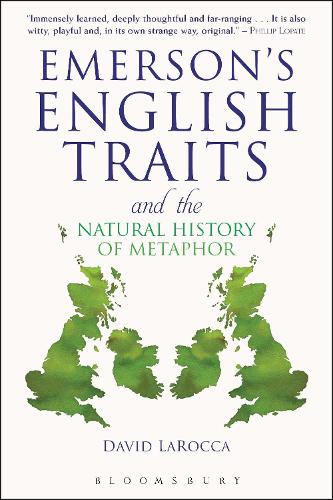
Книга Emerson's English Traits and the Natural History of Metaphor
Wide-ranging exploration of Emerson's style, his use of metaphor in particular, and his engagement with the major philosophical and literary currents of his day.
Metaphors are ubiquitous and yet—or, for that very reason—go largely unseen. We are all variously susceptible to a blindness or blurry vision of metaphors; yet even when they are seen clearly, we are left to situate the ambiguities, conflations and contradictions they regularly present—logically, aesthetically and morally. David LaRocca’s book serves as a set of ‘reminders’ of certain features of the natural history of our language—especially the tropes that permeate and define it. As part of his investigation, LaRocca turns to Ralph Waldo Emerson’s only book on a single topic, English Traits (1856), which teems with genealogical and generative metaphors—blood, birth, plants, parents, family, names and race. In the first book-length study of English Traits in over half a century, LaRocca considers the presence of metaphors in Emerson’s fertile text—a unique work in his expansive corpus, and one that is regularly overlooked. As metaphors are encountered in Emerson’s book, and drawn from a long history of usage in work by others, a reader may realize (or remember) what is inherent and encoded in our language, but rarely seen: how metaphors circulate in speech and through texts to become the lifeblood of thought.
"Emerson suggests in ‘The American Scholar’ that the final value of a book is that it is a resource. Emerson’s English Traits and the Natural History of the Metaphor is a resourceful and generative book, full of disparate insights and insinuations that future scholars will take up in reassessing the relevance of English Traits in an increasingly transatlantic field … In making a new case for the philosophical sophistication of English Traits, LaRocca has achieved his own Emersonian feat, the creation of a new ‘atmosphere in which to think’ (140)." - American Literary History
"I imagine David LaRocca having fun composing this book ... [I]t is an engaging experiment in criticism, an attempt to perform literary study in such a way as to bring its subject to life ... He has inventively devised a cabinet-like structure for his own book on Emerson’s cabinet-like structures; LaRocca sets about, assiduously and artfully, composing, gathering, sequencing and otherwise curating its contents ... The patient reader, the reader willing to make “interpretive shifts,” a reader capable of “loyalty to the present” and of reinforcing “an openness to the complexity of emerging phenomena,” will find [the] atmosphere by turns exhilarating, confusing, enticing, and drowsy with the hum of bees. Nevertheless, the reader must grant that removing Emerson’s writing from a museum and placing it in a florilegium does wonders for its constitution." - Journal of American Studies, 49, E15, reviewed by T. S. McMillin, Oberlin College, USA
"With this study, LaRocca emerges as a theorist as well as an important scholar of Emerson in an age when "theory" has become a footnote ... This study should be read by those who think themselves comfortable with Emerson, and by those who feel abandoned by theory. Mostly, though, this should be read by those who are in interested in figuring the thought that lies beyond reach. Summing Up: Highly recommended. Upper-division undergraduates and above." - Choice, reviewed by R. T. Prus, Southeastern Oklahoma State University, USA