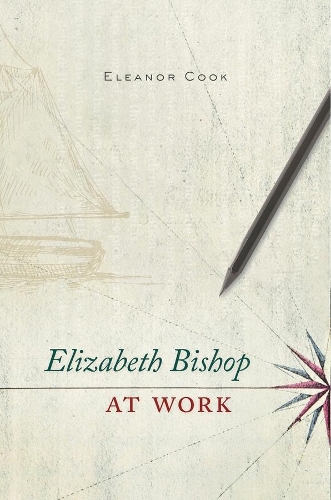
Книга Elizabeth Bishop at Work
In her lifetime Elizabeth Bishop was appreciated as a writer’s writer (John Ashbery once called her “the writer’s writer’s writer”). But since her death in 1979 her reputation has grown, and today she is recognized as a major twentieth-century poet. Critics and biographers now habitually praise Bishop’s mastery of her art, but all too often they have little to say about how her poetry does its sublime work—in the ear and in the mind’s eye.
Elizabeth Bishop at Work examines Bishop’s art in detail—her diction, syntax, rhythm, and meter, her acute sense of place, and her attention to the natural world. It is also a study of the poet working at something, challenging herself to try new things and to push boundaries. Eleanor Cook traces Bishop’s growing confidence and sense of freedom, from her first collection, North & South, to Questions of Travel, in which she fully realized her poetic powers, to Geography III and the breathtaking late poems, which—in individual ways—gather in and extend the poet’s earlier work. Cook shows how Bishop shapes each collection, putting to rest the notion that her published volumes are miscellanies.
Elizabeth Bishop at Work is intended for readers and writers as well as teachers. In showing exactly how Bishop’s poems work, Cook suggests how we ourselves might become more attentive readers and better writers. Bishop has been compared to Vermeer, and as with his paintings, so with her poems. They create small worlds where every detail matters.
"Cook, an eminent University of Toronto literary scholar, takes on one of the great 20th-century poets and offers a new perspective informed by her own poetic sensibility and skill at close reading. She examines Bishop’s art in detail—her diction, syntax, rhythm and meter, her sense of place and her alertness to the natural world—as well as her determination to push boundaries throughout her career in a study that is at once personal, partisan, rigorous and revelatory." - Times Higher Education
"Cook’s chronological examination of Bishop’s books, and the far-reaching connections she makes, facilitate more nuanced readings of Bishop’s later work…Her expertise and breadth of approach are as expansive as Bishop’s poetry is allusive." - Literary Review of Canada
"Cook’s most striking and persuasive discussions address how Bishop shaped and unified each discrete volume of verse, an evolution that marks her growing maturity as a conscious poetic craftswoman…Written in a lucid, uncluttered, sometimes personal style, this is an invaluable addition to the ever-expanding literature on Bishop." - Choice
"[Cook] is one of Bishop’s most attentive readers." - New York Review of Books