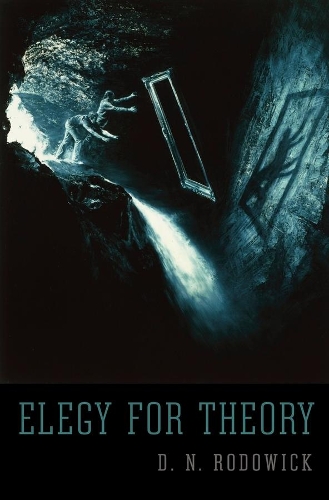
Rhetorically charged debates over theory have divided scholars of the humanities for decades. In Elegy for Theory, D. N. Rodowick steps back from well-rehearsed arguments pro and con to assess why theory has become such a deeply contested concept. Far from lobbying for a return to the "high theory" of the 1970s and 1980s, he calls for a vigorous dialogue on what should constitute a new, ethically inflected philosophy of the humanities.
Rodowick develops an ambitiously cross-disciplinary critique of theory as an academic discourse, tracing its historical displacements from ancient concepts of theoria through late modern concepts of the aesthetic and into the twentieth century. The genealogy of theory, he argues, is constituted by two main lines of descent—one that goes back to philosophy and the other rooted instead in the history of positivism and the rise of the empirical sciences. Giving literature, philosophy, and aesthetics their due, Rodowick asserts that the mid-twentieth-century rise of theory within the academy cannot be understood apart from the emergence of cinema and visual studies. To ask the question, "What is cinema?" is to also open up in new ways the broader question of what is art.
At a moment when university curriculums are everywhere being driven by scientism and market forces, Elegy for Theory advances a rigorous argument for the importance of the arts and humanities as transformative, self-renewing cultural legacies.
"While remaining rooted in the intellectual history of cinema studies, here Rodowick situates that history within a longer, larger story. Significantly, he seeks to show how theory’s changing applications to film exemplify its more general trajectory across the arts and humanities—a narrative whose sheer scale and complexity, he contends, now needs to be brought into focus… If theory moves forward by looking back, then Rodowick’s own work epitomizes the metacritical spirit it describes. In this essential respect, Elegy for Theory surpasses its humbly stated aim of ‘clarifying’ the history of a concept. While it is true that readers of Rodowick’s book will discover new insights into the story of theory, the exhilaration aroused by those ‘steep turns […] and surprising vistas’ stems as much from the structure and form of the story’s telling: to follow Rodowick’s argument is, in a way, to witness the spiraling swerve of theory enveloping and comprehending itself… Toward the end of this book, Rodowick writes of the era of theory that ‘to feel one’s self at the end of something inspires reflection on its ends.’ In itself, his inspired reflection revives the stream of ideas on which it reflects; if this is only an elegy, it’s one that instills its object with endless energy." - Los Angeles Review of Books
"Elegy for Theory is a daring, subtle, and important book… I take Elegy for Theory to be Rodowick’s attempt to do for cinema studies what Rorty’s Philosophy and the Mirror of Nature did for (some might say, to) philosophy, or what Thomas Kuhn’s The Structure of Scientific Revolutions, and more recently, Hans-Jorg Rheinberger’s On Historicizing Epistemology, have done for the history of science… Elegy for Theory is, among many other things, a model for thinking not only about how to do the kind of genealogical work on classical film theory that is by now well underway, but it also offers an important justification for pursuing this kind of work at all—and expressly for the sake of the discipline of film studies, as such… I read Elegy for Theory as an important provocation against the very certainty that follows from an absolute separation between theory and philosophy." - New Review of Film and Television Studies