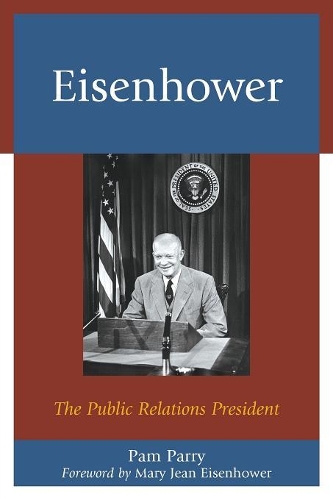
Книга Eisenhower: The Public Relations President
In the 1950s, public relations practitioners tried to garner respectability for their fledgling profession, and one international figure helped in that endeavor. President Dwight D. Eisenhower embraced public relations as a necessary component of American democracy, advancing the profession at a key moment in its history. But he did more than believe in public relations—he practiced it. Eisenhower changed how America campaigns by leveraging television and Madison Avenue advertising. Once in the Oval Office, he maximized the potential of a new medium as the first U.S. president to seek training for television and to broadcast news conferences on television. Additionally, Eisenhower managed the news through his press office, molding the role of the modern presidential press secretary. The first president to adopt a policy of full disclosure on health issues, Eisenhower survived (politically as well as medically) three serious illnesses while in office. The Eisenhower Administration was the most forthcoming on the president’s health at the time, even though it did not always live up to its own policy. In short, Eisenhower deserves credit as this nation’s most innovative public relations president, because he revolutionized America’s political communication process, forever changing the president’s relationship with the Fourth Estate, Madison Avenue, public relations, and ultimately, the American people.
"This volume offers a clear, compelling argument that few scholars (or media pundits) have dared to suggest: Dwight D. Eisenhower, not John F. Kennedy, was the first US president to truly embrace the use of public relations while in office . . . Parry uses archival materials and interviews with figures associated with Eisenhower to establish that Eisenhower had an under-appreciated strategic approach to public relations. She credits Eisenhower with reinventing the presidential news conference, reinvigorating the stature of the presidential press secretary, using mass media advertisements in his presidential runs, and creating the United States Information Agency to merge diplomacy with propaganda. Parry also points out that despite his intuition vis-à-vis public relations, Eisenhower suffered from poor speaking skills, a propensity for secrecy, and unwillingness to use the presidency in the service of the emerging civil rights movement. A welcome volume for those who wish to see how the presidency began to embrace strategic public relations. Includes extensive endnotes, a listing of archival sources, and photos. Summing Up: Recommended. All readers." - CHOICE
"Dwight D. Eisenhower had an illustrious career that has been well documented. Despite the vast literature on him, however, Pam Parry has managed to find an underexplored area. . . .Other mass media scholars have touched on Eisenhower’s attitudes toward the media, innovative use of television, and public relations’ savvy, but no one has taken the focused look at his impact on public relations as Parry has. . . .The book would make an ideal addition to a course in the history of public relations as well as in political science classes focused on the presidency. It is an interesting and informative look at a president about whom we continue to learn much." - American Journalism: A Media History Journal